Gunshot Residue (GSR)
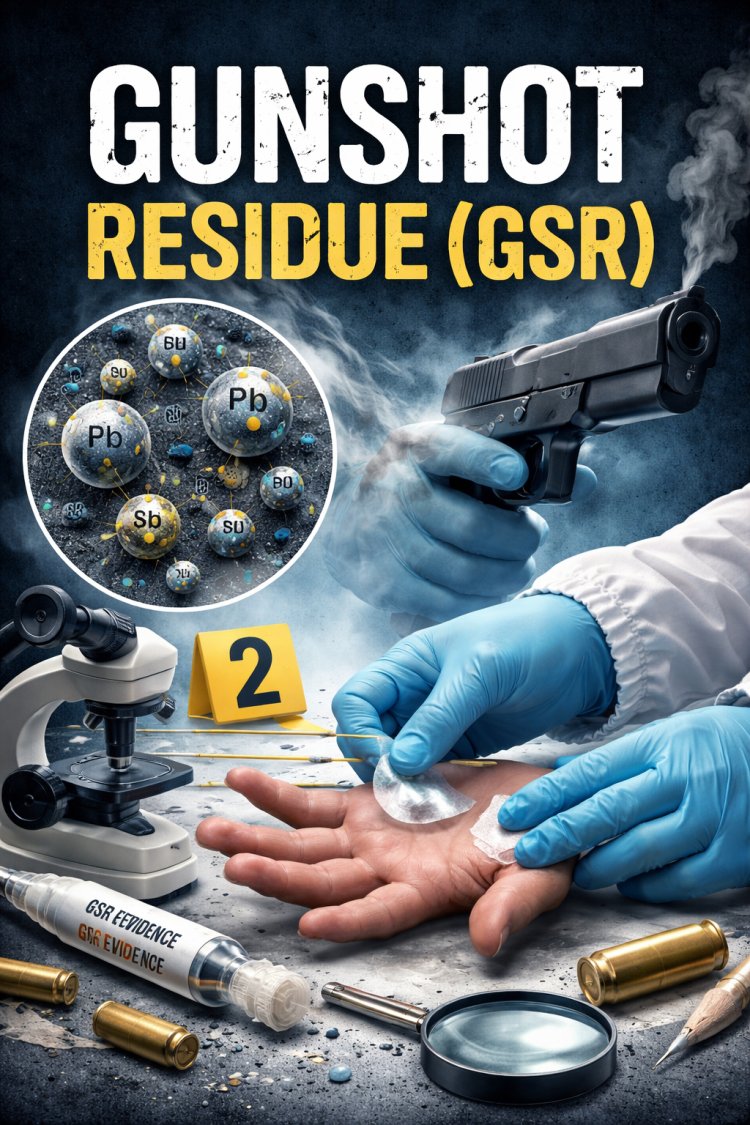
Gunshot Residue (GSR) refers to the microscopic particles and chemical substances that are released when a firearm is discharged. These particles originate from the primer, propellant (gunpowder), cartridge case, and bullet. After firing, GSR spreads into the surrounding air and deposits on the shooter’s hands, clothing, nearby surfaces, and sometimes on victims. GSR analysis is widely used in forensic science and criminal investigations to determine whether a person has recently fired a gun, handled a gun, or was close to a gun when it was fired.
1. How Gunshot Residue is Produced
When a firearm is fired, several rapid processes occur:
-
Primer Ignition
-
The firing pin strikes the primer at the base of the cartridge.
-
The primer contains explosive chemicals such as lead styphnate, barium nitrate, and antimony sulfide.
-
This creates a spark.
-
-
Propellant Combustion
-
The spark ignites the gunpowder (propellant).
-
The propellant rapidly burns and produces high-pressure gases.
-
-
Bullet Propulsion
-
Expanding gases push the bullet through the barrel.
-
During this explosion, tiny molten particles and gases are expelled from the firearm.
-
-
Residue Formation
-
The vaporized metals cool quickly in the air.
-
They form microscopic spherical particles that settle on nearby surfaces.
-
2. Composition of Gunshot Residue
GSR consists of both inorganic and organic components.
A. Inorganic GSR (IGSR)
These particles come mainly from the primer.
Common elements include:
-
Lead (Pb)
-
Barium (Ba)
-
Antimony (Sb)
These three together are considered the classic GSR signature.
Other possible elements:
-
Copper
-
Zinc
-
Aluminum
-
Calcium
-
Silicon
B. Organic GSR (OGSR)
These originate from the gunpowder propellant.
Examples include:
-
Nitroglycerin
-
Nitrocellulose
-
Diphenylamine
-
Ethyl centralite
3. Characteristics of GSR Particles
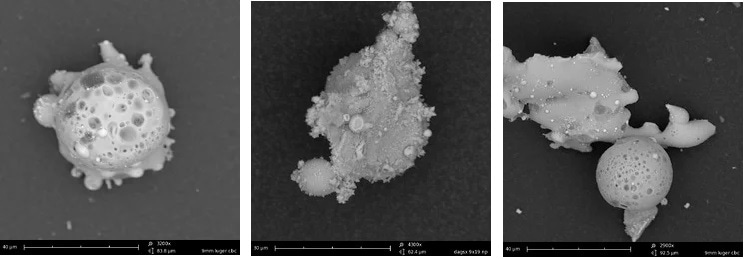
Typical GSR particles have distinctive properties:
-
Microscopic size
-
Usually 0.5–10 micrometers in diameter.
-
-
Spherical shape
-
Formed from molten droplets cooling in air.
-
-
Unique elemental composition
-
Combination of Pb–Ba–Sb is highly characteristic.
-
-
High temperature origin
-
Produced at temperatures above 1000°C.
-
These features help forensic scientists distinguish GSR from environmental dust or industrial particles.
4. Where GSR Can Be Found
After a gun is fired, residue can deposit on:
On the Shooter
-
Hands (especially thumb and back of hand)
-
Fingers
-
Clothing
-
Face
-
Hair
On the Victim
-
Clothing
-
Skin
-
Entry wound area
On Surrounding Objects
-
Nearby furniture
-
Vehicles
-
Walls
-
Floor
5. Collection of Gunshot Residue
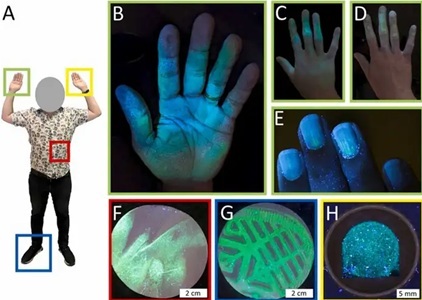
GSR must be collected quickly because it can be easily lost.
Methods of Collection
-
Adhesive Stubs (Tape Lift Method)
-
Sticky carbon tape pressed on the suspect’s hands.
-
-
Swabbing
-
Cotton swabs with acid solution.
-
-
Vacuum Collection
-
Used for clothing or large surfaces.
-
-
Clothing Collection
-
Entire garment may be seized for testing.
-
Collection is usually done within 4–6 hours after firing for best results.
6. Laboratory Analysis of GSR
1. SEM–EDX Method (Most Reliable)
Scanning Electron Microscope with Energy Dispersive X-ray Spectroscopy
Process:
-
Detects particle shape
-
Identifies chemical composition
Advantages:
-
Highly accurate
-
Can detect Pb–Ba–Sb particles
2. Atomic Absorption Spectroscopy (AAS)
Detects:
-
Lead
-
Barium
-
Antimony
3. Neutron Activation Analysis (NAA)
Very sensitive technique but rarely used now.
4. Chromatography
Used to detect organic residues from gunpowder.
7. Factors Affecting GSR Presence
GSR may disappear due to:
-
Washing hands
-
Rubbing hands
-
Environmental contamination
-
Time delay
-
Movement
Typically, most GSR disappears within 4–6 hours.
8. Forensic Significance of GSR
GSR evidence can help answer several forensic questions:
-
Did the suspect fire a gun?
-
Was the person near a firearm discharge?
-
Did the person handle a gun or cartridge?
-
What was the firing distance?
However, GSR cannot conclusively prove someone fired a weapon, only that they may have been in contact with firearm discharge.
9. Limitations of GSR Evidence
-
Secondary transfer
-
GSR can transfer from one person to another.
-
-
Environmental contamination
-
Brake pads, fireworks, or industrial sources may contain similar elements.
-
-
Modern lead-free ammunition
-
Harder to detect traditional Pb–Ba–Sb particles.
-
-
Loss over time
-
Particles easily fall off.
-
10. Applications of GSR in Criminal Investigation
GSR analysis is used in:
-
Homicide investigations
-
Suicide determination
-
Police shooting cases
-
Reconstruction of shooting incidents
-
Determining firing distance
Follow cyberdeepakyadav.com on
Facebook, Twitter, LinkedIn, Instagram, and YouTube
What's Your Reaction?