Audio Forensics
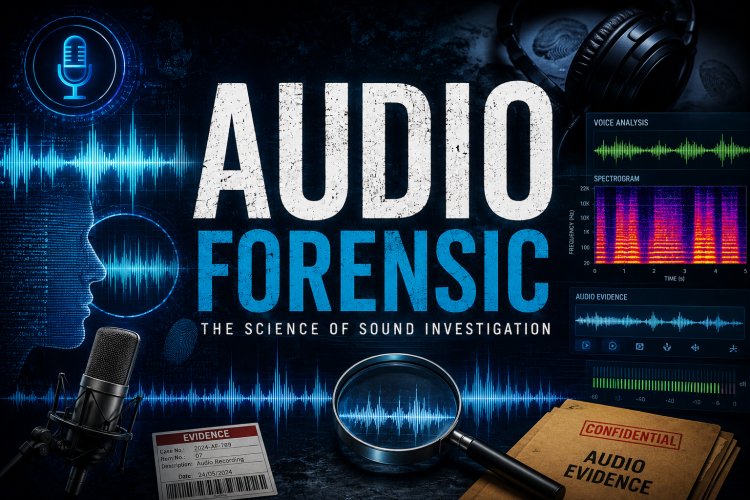
Audio forensics is a branch of forensic science that deals with the scientific examination, analysis, authentication, enhancement, and interpretation of audio recordings for legal investigations and court evidence.
It is widely used in:
- Criminal investigations
- Cybercrime cases
- Terrorism investigations
- Voice authentication
- Surveillance analysis
- Court evidence verification
What Is Audio Forensics?
Audio forensics involves analyzing:
- Recorded voices
- Phone calls
- CCTV audio
- Hidden recordings
- Threat calls
- Voice notes
- Digital audio files
The goal is to determine:
- Who spoke?
- Was the audio edited?
- What exactly was said?
- Is the recording authentic?
- Can background sounds reveal location or time?
Main Objectives of Audio Forensics
1. Voice Identification
Comparing a suspect’s voice with recorded evidence.
Used in:
- Threat calls
- Kidnapping cases
- Terrorism
- Fraud investigations
2. Audio Authentication
Determining whether an audio recording has been:
- Edited
- Cut
- Spliced
- Manipulated
- AI-generated
3. Audio Enhancement
Improving poor-quality recordings by removing:
- Background noise
- Echo
- Distortion
- Static sounds
4. Speech Reconstruction
Recovering unclear or damaged speech recordings.
5. Speaker Profiling
Estimating:
- Gender
- Age
- Accent
- Emotional condition
- Regional origin
Types of Audio Evidence
Common Sources
- Mobile phone recordings
- WhatsApp voice messages
- CCTV audio
- Wiretaps
- Security recordings
- Radio communication
- Smart devices
- Podcasts/social media videos

Important Components of Audio Forensics
1. Spectrogram Analysis
A spectrogram visually represents:
- Frequency
- Pitch
- Sound intensity
- Voice patterns
Used to compare voices scientifically.
Example:
This basic waveform equation represents how sound signals are analyzed.
2. Voice Biometrics
Every person has unique:
- Pitch
- Tone
- Vocal tract structure
- Speaking style
Voice biometrics creates a “voiceprint.”
3. Waveform Analysis
Investigators study:
- Amplitude
- Signal breaks
- Compression artifacts
- Editing traces
4. Metadata Examination
Metadata reveals:
- Recording device
- Time/date
- Editing software
- File format
- GPS data (sometimes)
Audio Forensic Process
Step 1: Evidence Collection
Investigators securely collect:
- Original recordings
- Devices
- Storage media
Chain of custody is maintained carefully.
Step 2: Preservation
Audio files are copied using forensic imaging tools to avoid modification.
Step 3: Enhancement
Special software removes:
- Traffic noise
- Wind noise
- Electrical interference
Step 4: Authentication
Experts detect:
- Voice cloning
- AI manipulation
- Deepfake speech
- Audio tampering
Step 5: Voice Comparison
Suspect voice samples are compared with questioned recordings.
Step 6: Reporting
Experts prepare forensic reports for court presentation.

Technologies Used in Audio Forensics
AI & Machine Learning
Modern AI detects:
- Deepfake voices
- Synthetic speech
- Voice manipulation
Signal Processing
Advanced digital filtering improves:
- Clarity
- Frequency balance
- Speech intelligibility
Natural Language Processing (NLP)
Analyzes:
- Speech patterns
- Keywords
- Emotional tone
Voice Identification Methods
1. Auditory Method
Human experts compare voices manually.
2. Spectrographic Method
Scientific voiceprint comparison.
3. Automatic Speaker Recognition
AI-based matching systems.
Popular Audio Forensic Tools
Software
- Adobe Audition
- Audacity
- iZotope RX
- Cedar Cambridge
Follow cyberdeepakyadav.com on
Facebook, Twitter, LinkedIn, Instagram, and YouTube
What's Your Reaction?