Bloodstain Pattern Analysis (BPA)
Bloodstain Pattern Analysis (BPA) is a forensic discipline that studies the size, shape, distribution, and location of bloodstains at a crime scene to reconstruct events. It helps investigators understand:
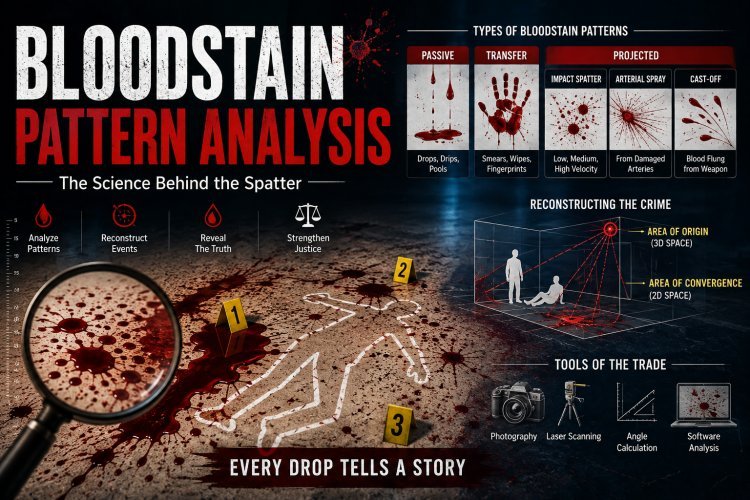
- What happened
- How it happened
- Direction and force of bloodshed
- Position of victim and assailant

Principles of BPA
1. Physics of Blood Drops
- Blood behaves as a fluid and follows laws of physics
- Surface tension forms droplets
- Gravity and external force influence shape
2. Locard’s Exchange Principle
“Every contact leaves a trace”
Blood acts as transfer evidence between victim, suspect, and scene
Types of Bloodstain Patterns

1. Passive Bloodstains
- Formed only by gravity
- Includes:
- Drops
- Pools
- Drips
- Indicates minimal external force
2. Transfer Bloodstains
- Occurs when a bloody object contacts a surface
- Examples:
- Handprints
- Footprints
- Smears (wipe/swipe)
- Helps identify movement or contact
3. Projected Bloodstains

- Caused by force greater than gravity
- Types include:
- Impact spatter
- Low velocity (large drops)
- Medium velocity (beating/stabbing)
- High velocity (gunshot mist-like)
- Arterial spray (from damaged arteries)
- Cast-off (blood flung from weapon)
- Impact spatter
Key Concepts in BPA
1. Angle of Impact
- Determines angle at which blood hits surface
- Formula:
Angle = sin⁻¹ (width ÷ length) - Smaller angle → elongated stain
2. Direction of Travel
- Tail or pointed end shows direction of movement
- Helps identify source and motion
3. Area of Convergence
- Point where blood originated (2D)
- Determined by tracing lines backward
4. Area of Origin
- 3D location of blood source
- Uses trigonometry and stringing method

5. Velocity of Blood
| Type | Cause | Appearance |
|---|---|---|
| Low | Gravity | Large round drops |
| Medium | Blunt force | Smaller, irregular |
| High | Gunshot | Fine mist |
Methods & Techniques
1. Visual Examination
- Observing patterns, distribution, size
2. Photography & Documentation
- High-resolution images
- Scales and markers used
3. Stringing Method
- Strings used to trace back trajectories
4. Software Analysis
- 3D reconstruction tools (e.g., FARO, HemoSpat)
Importance in Investigation
- Reconstructs sequence of events
- Supports or contradicts witness statements
- Determines type of weapon used
- Helps identify positions of victim & attacker
Limitations of BPA
- Cannot always determine exact timing
- Requires expert interpretation
- Scene contamination can mislead results
- Similar patterns may have different causes
Follow cyberdeepakyadav.com on
Facebook, Twitter, LinkedIn, Instagram, and YouTube
What's Your Reaction?