Hair Analysis for Long-Term Drug Detection in Forensic Toxicology
Hair analysis is an important technique in forensic toxicology for detecting a person's past exposure to drugs, medications, and certain toxic substances. Unlike blood or urine, which generally provide a relatively short detection window, hair can preserve evidence of exposure over weeks to months and, depending on hair length and the analytical question, potentially much longer periods. This makes hair particularly useful when investigators need retrospective information about drug exposure. A major advantage is that hair is a relatively stable keratinized matrix and can be collected with comparatively little invasiveness. However, a positive hair result should not automatically be interpreted as proof of a particular dose or intentional drug use. A 2026 review found that relationships between hair concentration and drug dose are inconsistent for many substances
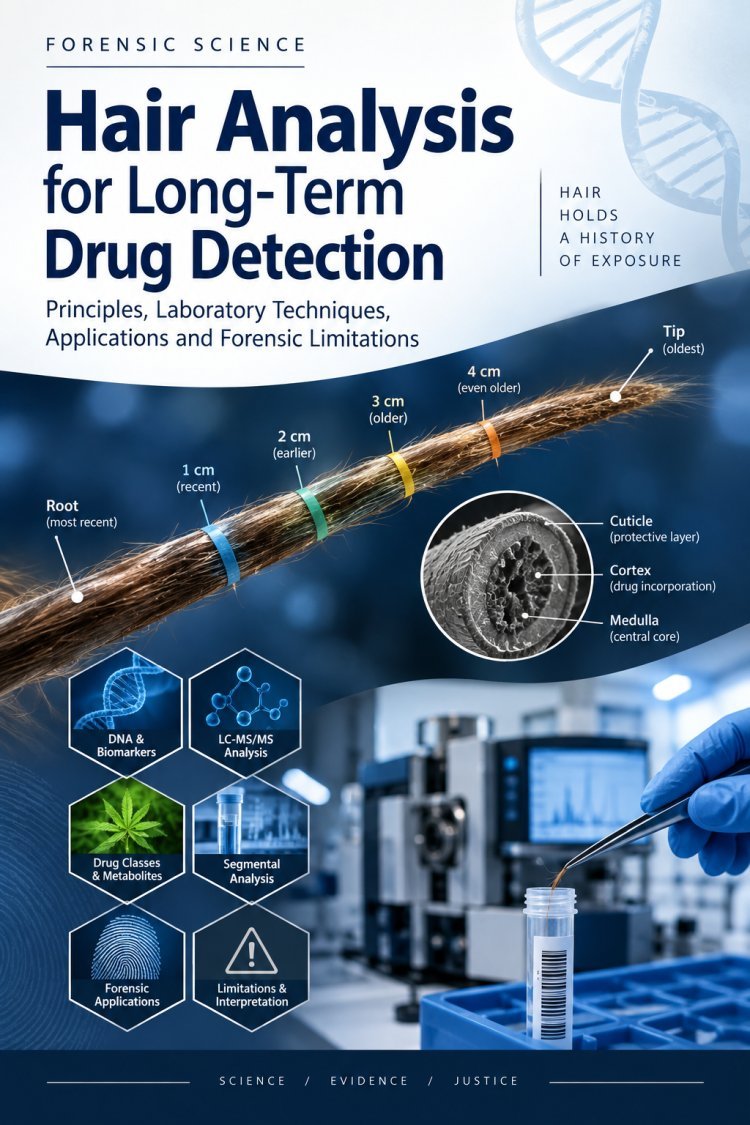
Why is hair useful for drug detection?
When a drug enters the body, or its metabolites are produced, some compounds can reach the hair follicle through the bloodstream. During formation of the hair shaft, compounds can become incorporated into the keratinized structure.
There are also other possible routes:
Drug in body → bloodstream → hair follicle → growing hair
and
Drug/metabolite → sweat/sebum → hair surface
External environmental contamination can also contribute to drug residues on hair, which is one reason interpretation requires careful laboratory procedures.
Structure of human hair
Understanding hair anatomy is important because drugs are primarily investigated in the hair shaft.
A hair consists mainly of keratin, a structural protein. The shaft has three principal regions:
1. Cuticle
The outer protective layer made of overlapping scales.
2. Cortex
The major structural region of the hair. It contains keratin and melanin pigments and is particularly important in toxicological hair analysis.
3. Medulla
The central region, which may be continuous, discontinuous or absent depending on the hair.
The National Institute of Standards and Technology (NIST) describes human hair as a keratin-based structure, while forensic references describe the cuticle, cortex and medulla as the principal regions of the hair shaft.

How do drugs become incorporated into hair?
The exact mechanisms are complex and are still an area of forensic research.
A. Bloodstream pathway
After a substance is absorbed into the body:
Drug → blood → capillaries around follicle → hair matrix → keratinized hair
During hair formation, drugs or metabolites can become associated with the developing hair.
B. Sweat pathway
Drugs or metabolites present in sweat can contact the hair and contribute to drug deposition.
C. Sebum pathway
Sebaceous glands produce sebum. Drug-related compounds present in sebum can also interact with hair.
D. External contamination
Hair may come into contact with drug-containing powders, smoke, aerosols or contaminated surfaces.
Therefore, detecting a substance in hair requires careful consideration of whether the finding represents systemic exposure, external contamination, or a combination of mechanisms.
Hair growth and the detection window
A commonly used forensic approach is segmental analysis.
Head hair is often divided into segments measured from the proximal/root end toward the distal/tip end.
A rough working assumption is that 1–2 cm of head hair may correspond approximately to 1–2 months, but actual growth varies between individuals and across hair cycles. Therefore, segment length should not be treated as an exact calendar clock.
Example
Imagine a laboratory receives approximately 6 cm of scalp hair:
| Segment | Approximate period* |
|---|---|
| 0–1 cm | Most recent period |
| 1–2 cm | Earlier period |
| 2–3 cm | Earlier period |
| 3–4 cm | Earlier period |
| 4–5 cm | Older period |
| 5–6 cm | Oldest section |
*These are approximate time relationships, not exact dates.

Segmental analysis can therefore provide information about patterns of exposure over time, rather than simply answering whether a substance was present or absent.
Sample collection
For forensic testing, scalp hair is commonly collected from the posterior vertex region of the head.
A typical collection involves:
- Selecting an appropriate scalp location.
- Cutting hair as close to the scalp as practical.
- Maintaining the root-to-tip orientation.
- Recording the sample location and approximate length.
- Packaging and labeling appropriately.
- Maintaining chain of custody.
- Sending the specimen to the forensic laboratory.
Maintaining orientation is important when the objective is to perform segmental analysis, because the laboratory needs to distinguish the newer proximal portion from the older distal portion.
Laboratory examination
Hair drug analysis generally involves several stages.
Step 1 — Visual examination
The laboratory records characteristics such as:
- Color
- Length
- Condition
- Cosmetic treatment
- Sample orientation
- Possible contamination
Step 2 — Washing/decontamination
The sample may undergo a validated washing procedure to reduce external contaminants.
However, washing itself can affect analyte concentrations, so the procedure must be appropriately validated and interpreted.
Step 3 — Segmentation
The hair may be divided into predetermined lengths, such as 1 cm or 2 cm segments, depending on the purpose of the examination.
Step 4 — Pulverization or preparation
The hair is mechanically processed to increase the surface area available for extraction.
Step 5 — Extraction
Target drugs and metabolites are extracted from the hair matrix.
Step 6 — Instrumental analysis
Modern laboratories may use highly sensitive analytical techniques, particularly:
- LC-MS/MS
- GC-MS/MS
- High-resolution mass spectrometry in some applications

Validated LC-MS/MS workflows can simultaneously investigate multiple classes of drugs and metabolites.
Drugs that can be investigated
Depending on the laboratory's validated method, hair testing can investigate substances such as:
Stimulants
- Cocaine
- Amphetamine
- Methamphetamine
Opioids
- Heroin-related analytes
- Morphine
- Codeine
- Other opioids
Cannabis-related compounds
- THC
- THC metabolites
Benzodiazepines
- Diazepam
- Alprazolam
- Other benzodiazepines
Other substances
- Ketamine
- Buprenorphine
- Selected new psychoactive substances
- Selected therapeutic drugs
The exact testing panel varies according to the laboratory and case requirements. A published LC-MS/MS workflow, for example, describes simultaneous analysis of multiple drug classes including opiates, amphetamines, cocaine, ketamine, buprenorphine, benzodiazepines and cannabinoids.

Why LC-MS/MS is important
Liquid Chromatography–Tandem Mass Spectrometry (LC-MS/MS) is particularly valuable because forensic hair samples can contain very small amounts of analytes.
The basic analytical concept is:
Hair sample → extraction → separation by liquid chromatography → mass spectrometric detection → identification/quantification
Chromatography separates compounds, while mass spectrometry provides highly selective detection based on their molecular characteristics
Segmental analysis
One of the most interesting applications is segmental or micro-segmental hair analysis.
Instead of analyzing the entire hair sample together, investigators analyze different sections separately.
For example:
Root → Segment 1 → Segment 2 → Segment 3 → Segment 4 → Tip
The resulting concentrations can be plotted against segment position
Research on micro-segmental analysis has demonstrated that different exposure patterns can produce different distribution profiles along individual hair strands.
This can potentially help investigators distinguish patterns such as:
Single exposure → localized peak
Repeated exposure → broader/elevated distribution
But these patterns should be interpreted cautiously because hair growth, incorporation mechanisms and analytical variability can affect the distribution.
Hair analysis vs urine vs blood
| Feature | Hair | Urine | Blood |
|---|---|---|---|
| Detection window | Long | Generally shorter | Generally very short |
| Collection | Relatively non-invasive | Non-invasive | Invasive |
| Historical information | Strong | Limited | Limited |
| Segmental history | Possible | No | No |
| Dose estimation | Not reliable | Limited | More directly related to current concentration |
| External contamination concern | Significant | Lower | Lower |
| Main forensic value | Retrospective exposure | Recent exposure | Recent/current exposure |
Hair therefore provides historical information, whereas blood and urine are generally more useful for assessing more recent exposure.
Major forensic applications
1. Investigation of chronic drug exposure
Hair can provide retrospective evidence of repeated exposure.
2. Drug-facilitated crime investigations
Hair may sometimes be useful when the suspected exposure occurred sufficiently long ago that conventional biological specimens are no longer informative.
3. Child protection cases
Hair analysis can be used as part of an investigation into possible drug exposure of children.
4. Doping investigations
Hair can potentially provide information about longer-term exposure to selected substances.
5. Forensic toxicology
Hair can complement blood, urine and other specimens when investigators need a longer retrospective window.
These applications have been discussed in forensic toxicology literature, including investigations involving drug exposure, doping, child protection and drug-facilitated crime.

Important limitations
This is one of the most important sections of the topic.
1. Hair does not provide a reliable dose measurement
A high concentration does not necessarily mean a person consumed a high dose.
A 2026 systematic review found weak or inconsistent relationships between dose and hair concentration for several commonly investigated drugs.
2. External contamination
Drugs can potentially reach hair from the environment, particularly when individuals are exposed to drug-containing materials.
3. Hair color and melanin
Drug incorporation can differ according to melanin content. This can complicate comparisons between individuals with different hair pigmentation.
4. Cosmetic treatment
Bleaching, dyeing, straightening and other treatments can alter the hair matrix and potentially affect measured drug concentrations.
5. Different growth rates
Hair does not grow at exactly the same rate for everyone, and individual hairs can be at different stages of the hair-growth cycle.
6. Passive exposure
Finding a drug or metabolite in hair does not automatically establish intentional consumption. Interpretation depends on the analyte, concentration, metabolites, contamination controls and case circumstances.
Hair analysis as a forensic timeline
One of the most fascinating concepts is that hair can function somewhat like a biological timeline.

For example:
Scalp
⬇️
0–1 cm → recent history
⬇️
1–2 cm → earlier history
⬇️
2–3 cm → older history
⬇️
3–4 cm → still older history
⬇️
Tip → oldest available portion
But this should be understood as an approximate chronological framework, not an exact date-stamping mechanism. Individual growth rates and hair-cycle effects create uncertainty.
Follow cyberdeepakyadav.com on
Facebook, Twitter, LinkedIn, Instagram, and YouTube
What's Your Reaction?