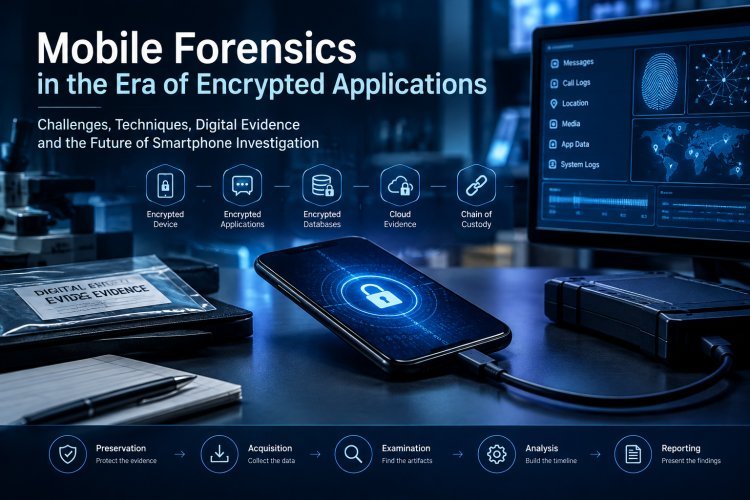
Mobile Forensics in the Era of Encrypted Applications
Mobile phones have evolved from simple communication devices into digital repositories of personal, financial, social, professional, and location-related information. Modern smartphones can contain photographs, videos, emails, chat messages, call records, GPS information, browser history, documents, cloud-account information, application data, and records generated by connected devices. For forensic investigators, this creates both an opportunity and a major challenge: encryption and privacy technologies increasingly protect the very data investigators need to examine. Applications such as messaging, banking, cloud-storage, password managers, and social-media platforms may use encryption at different layers. Some protect data while it is being transmitted, while others protect data stored on the device. End-to-end encrypted (E2EE) applications can additionally prevent the service provider from accessing the readable content of messages.
What is Mobile Forensics?
Mobile forensics is the scientific process of identifying, preserving, acquiring, examining, analyzing, and reporting digital evidence obtained from mobile devices.
It may involve:
- Smartphones
- Tablets
- Smartwatches
- SIM/eSIM-related information
- SD cards
- Mobile applications
- Cloud-linked accounts
- Connected IoT devices
A typical investigation attempts to answer questions such as:
- Who used the device?
- When was it used?
- Which applications were accessed?
- Who communicated with whom?
- What files were created, downloaded, or deleted?
- Where was the device located?
- What happened immediately before and after an incident?
- Can application activity be correlated with other evidence?
Why Encryption Has Changed Mobile Forensics
Traditional mobile forensic extraction often relied on investigators obtaining a logical or physical representation of device data and then examining the resulting filesystem or application databases.
Modern smartphones introduce multiple security layers.
Simplified architecture
User → Application → Operating System → File System → Hardware
Security mechanisms may exist at every layer.
For example:
Application encryption
↓
File/database encryption
↓
Operating-system security
↓
Full-device encryption
↓
Secure hardware / key storage
Consequently, obtaining the physical device does not necessarily mean obtaining readable evidence.
Types of Encryption Relevant to Mobile Forensics
A. Encryption in Transit
This protects information while it travels between devices and servers.
Examples include:
- TLS
- HTTPS
- Encrypted API communications
It primarily protects data during transmission.
B. Encryption at Rest
This protects information stored on a device.
Modern smartphones commonly use encryption to protect:
- User files
- Application databases
- Photos
- Credentials
- System information
If the device is locked, access to cryptographic keys may be restricted.
C. End-to-End Encryption
End-to-end encryption is particularly important in mobile investigations.
In an E2EE communication system:
Sender → encrypted message → recipient
The service may transport the encrypted information without possessing the necessary key to decrypt the message content.
This means investigators may not simply obtain readable conversations from the service provider.
However, E2EE does not mean that a phone contains no forensic evidence.
Other artifacts may remain available depending on the device, operating system, application, configuration, backups, and acquisition state.

Encryption vs. Anonymity
These concepts should not be confused.
Encryption
Protects the content of information.
Anonymity
Attempts to hide the identity or traceability of a user.
A person may use an encrypted messaging application while still leaving other traces such as:
- Device identifiers
- Account information
- Network metadata
- Application usage
- Local databases
- Notifications
- Contact relationships
- Timestamps
- Backup artifacts
Therefore:
Encrypted communication does not necessarily mean invisible communication.
Why Encrypted Applications Are Difficult for Investigators
Encrypted applications can create several forensic challenges.
1. Encrypted databases
Application databases may be stored in encrypted form.
2. Protected encryption keys
Keys may be protected using operating-system security mechanisms and hardware-backed security.
3. Locked devices
A locked smartphone can restrict access to protected data.
4. Secure hardware
Modern devices can use dedicated secure hardware or trusted execution environments to protect cryptographic material.
5. Application-specific security
Different applications use different:
- Database formats
- Encryption mechanisms
- Key-management systems
- Backup architectures
- Authentication systems
6. Cloud complexity
Evidence may be distributed across:
Phone + application server + cloud backup + linked devices
This creates a much more complex forensic environment.
Major Sources of Evidence
Even when message content is inaccessible, investigators may examine other sources.
A. Application Artifacts
Applications can leave artifacts such as:
- Installation information
- Application databases
- Cached files
- Configuration files
- Account identifiers
- Timestamps
- Media references
- Contact information
- Notification artifacts
The exact artifacts vary significantly between applications and operating systems.
B. System Artifacts
Investigators may examine:
- Operating-system logs
- Usage information
- System databases
- Installed applications
- Device configuration
- Wi-Fi records
- Bluetooth information
- Location-related artifacts
- Time information
These artifacts can help reconstruct user activity.
C. Notifications
Notifications can sometimes become important evidence.
For example, a notification may reveal that a message or event occurred even when the underlying application database is inaccessible.
However, investigators must carefully establish:
- Whether the notification was generated by the application
- Whether the content was complete
- Whether it was subsequently modified or deleted
- What time source was used

Metadata: Extremely Important in Encrypted-App Investigations
When message content is unavailable, metadata can become particularly valuable.
Metadata may include information such as:
- Time
- Sender/recipient identifiers
- File size
- Device information
- Application activity
- Connection information
- Event sequence
For example, investigators might not be able to read a particular encrypted message, but other evidence may establish:
Device A communicated with Account B at a particular time, followed by a file download and subsequent location change.
This can help investigators reconstruct a timeline without relying exclusively on message content.
Mobile Forensic Acquisition Methods
Mobile acquisition generally falls into several categories.
1. Manual Acquisition
The investigator manually examines information displayed on the device.
Advantages
- Simple
- Useful when other extraction methods are unavailable
Limitations
- Limited scope
- Difficult to reproduce completely
- Greater risk of missing artifacts
2. Logical Acquisition
Logical acquisition retrieves accessible data through supported interfaces or operating-system mechanisms.
Potential evidence may include:
- Contacts
- Messages
- Call records
- Calendar
- Some application data
- Media
- Device information
The amount of data depends heavily on the device and operating system.
3. File-System Acquisition
A filesystem-level acquisition attempts to obtain a broader representation of accessible filesystem content.
It can provide investigators with more information than a basic logical extraction, including application directories and databases when accessible.
4. Physical Acquisition
A physical acquisition attempts to obtain data from the device's underlying storage.
Historically, physical extraction was particularly useful for recovering deleted or otherwise inaccessible information.
However, modern smartphones use stronger encryption and secure hardware, making traditional physical acquisition increasingly difficult.
The Role of Authentication
One of the most important variables in mobile forensics is the device's authentication state.
Examples include:
- PIN
- Password
- Pattern
- Biometric authentication
- Passcode-protected application
- Hardware-backed authentication
The investigator must document the device state carefully because the available evidence may differ depending on whether the device is:
Unlocked → locked → rebooted → authenticated again
Modern operating systems may place different categories of data into different protection states.
Encryption Key Management
Understanding key management is essential for advanced mobile forensic analysis.
A simplified model is:
User authentication
↓
Authentication-derived secret
↓
Key-encryption mechanism
↓
Data encryption key
↓
Encrypted data
Modern smartphones may also incorporate hardware-backed cryptographic components.
This makes it considerably more difficult to obtain encryption keys simply by copying storage.
Secure Enclaves and Trusted Hardware
Modern mobile devices can use dedicated security components designed to protect sensitive cryptographic operations.
Examples include hardware-backed security architectures such as:
- Secure Enclave-type systems
- Trusted execution environments
- Hardware-backed keystores
- Secure elements
From a forensic perspective, these mechanisms can prevent investigators from simply extracting cryptographic keys from ordinary storage.
Therefore, modern mobile forensics increasingly requires understanding hardware, firmware, operating systems, and cryptographic architecture, rather than only filesystem analysis.
Encrypted Messaging Applications
Messaging applications represent one of the most challenging areas.
A typical modern messaging architecture can involve:
User Device A
↓
Encryption
↓
Messaging Infrastructure
↓
Encrypted Delivery
↓
User Device B
Depending on the application's design, investigators may encounter:
- Encrypted message databases
- Encrypted attachments
- Protected keys
- Limited server-side content
- Local caches
- Notifications
- Backup artifacts
- Linked-device artifacts
The forensic question therefore becomes:
Where does evidence exist, and in what form?
Cloud Backups and Mobile Forensics
Cloud services have transformed mobile investigations.
A smartphone may synchronize information with:
- Cloud storage
- Application backups
- Email services
- Photo services
- Device backups
- Contact synchronization
- Other linked devices
Therefore, investigators may need to consider:
Device evidence + cloud evidence + application evidence
rather than examining the phone in isolation.
Importantly, investigators must determine whether a backup is:
- Encrypted
- End-to-end encrypted
- Password protected
- Automatically generated
- Older or newer than the device state
Deleted Data in the Encrypted Era
Previously, investigators sometimes recovered deleted information from unallocated storage or database remnants.
Modern encryption and storage technologies complicate this.
Factors include:
- Database deletion behavior
- Encryption
- File-system architecture
- Storage management
- Garbage collection
- Secure deletion mechanisms
- Application-specific retention
Therefore:
Deleted does not always mean recoverable, and encrypted does not always mean unrecoverable.
The investigator must determine what artifacts actually remain rather than assuming either outcome.
Anti-Forensics and Encrypted Applications
Some criminals may deliberately attempt to reduce forensic visibility.
Potential techniques include:
- Secure deletion
- Encrypted containers
- Application locking
- Data wiping
- Steganography
- Anonymous accounts
- Disposable communication channels
- Manipulation of timestamps
- Use of multiple devices
This creates an important relationship:
Encryption + anti-forensics = increased forensic complexity
However, investigators should distinguish between legitimate privacy technologies and deliberate evidence destruction.
Investigation Workflow
A modern encrypted-mobile investigation can follow this general workflow:
Step 1 — Identification
Identify:
- Device
- Model
- Operating system
- SIM/eSIM configuration
- Applications
- Connected devices
Step 2 — Preservation
Prevent unnecessary alteration of evidence.
Document:
- Device condition
- Screen state
- Network state
- Power state
- Date/time
- Visible notifications
Step 3 — Isolation
Depending on circumstances and legal authority, investigators may need to prevent remote alteration or synchronization.
Step 4 — Documentation
Record:
- Device identifiers
- Physical condition
- Acquisition circumstances
- Examiner
- Date and time
- Actions performed
Step 5 — Acquisition
Use the most appropriate validated acquisition method available.
Step 6 — Validation
Verify that the acquired data is consistent and has not been improperly altered.
Step 7 — Examination
Identify relevant:
- Applications
- Databases
- Media
- Logs
- Accounts
- Metadata
- System artifacts
Step 8 — Analysis
Build relationships between artifacts.
Step 9 — Timeline Reconstruction
Correlate:
communication + application activity + location + device events + external evidence
Step 10 — Reporting
Clearly distinguish:
- Observed facts
- Derived findings
- Interpretation
- Limitations
Timeline Analysis
Timeline reconstruction is one of the most powerful approaches when message content is unavailable.
Imagine investigators establish:
10:05 — Messaging application opened
↓
10:07 — Notification received
↓
10:10 — Device location changed
↓
10:18 — Image downloaded
↓
10:22 — Application closed
None of these events alone may prove a particular activity.
But together they can provide a chronological context that investigators can compare with other evidence.
Correlation Is More Important Than a Single Artifact
A modern forensic investigation should avoid relying on one artifact.
Instead, investigators can correlate:
Mobile device
Cloud records
Network information
CCTV
Financial transactions
Other seized devices
Application artifacts
This creates a stronger evidentiary picture.
For example:
Phone artifact → timestamp → network record → location information → CCTV
The goal is to determine whether independent sources support the same event.
Tools Used in Mobile Forensics
Professional laboratories may use specialized commercial and open-source tools depending on the device and investigation.
Examples include:
- Cellebrite UFED / Inseyets
- Magnet AXIOM
- Oxygen Forensic Detective
- MSAB XRY
- MOBILedit Forensic
- Belkasoft Evidence Center
- Autopsy for broader digital-forensic examination
- ADB-based tools where appropriate and legally authorized
No single tool should be considered capable of extracting everything from every modern smartphone.

A critical forensic principle is: Tool output should be treated as evidence requiring validation and interpretation, not as unquestionable truth.
Chain of Custody
Encryption does not eliminate the need for traditional forensic principles.
Every evidence item should have proper documentation covering:
- Who collected it
- When it was collected
- Where it was collected
- How it was transported
- Who examined it
- What acquisition process was used
- What tools were used
- What hashes or integrity mechanisms were applied where appropriate
The objective is to demonstrate:
The evidence examined is the evidence collected, and its integrity has been maintained.
Validation and Reproducibility
Because mobile operating systems and applications change rapidly, forensic laboratories should validate their tools and procedures.
Important considerations include:
- Tool version
- Operating-system version
- Application version
- Device model
- Acquisition method
- Extraction limitations
- Parsing errors
- Timestamp interpretation
Two tools may sometimes produce different interpretations of the same artifact.
Therefore, investigators should understand how the tool generated its result.
Artificial Intelligence in Encrypted Mobile Forensics
AI is increasingly useful after evidence has been acquired.
Possible applications include:
Automated artifact classification
AI can help categorize large volumes of extracted information.
Image analysis
Machine learning can assist with:
- Object recognition
- Image categorization
- Similar-image grouping
Timeline analysis
AI can help identify relationships between thousands or millions of events.
Entity resolution
It may assist investigators in connecting:
- Usernames
- Accounts
- Phone numbers
- Email addresses
- Devices
Anomaly detection
AI can identify unusual patterns in device or application activity.
However, AI-generated conclusions must remain auditable and independently verifiable.
Follow cyberdeepakyadav.com on
Facebook, Twitter, LinkedIn, Instagram, and YouTube
What's Your Reaction?