Vehicle Forensics and Connected-Car Investigations
Modern vehicles are no longer just mechanical machines. A connected vehicle can contain dozens of electronic control units (ECUs), infotainment systems, GPS/navigation functions, Bluetooth connections, telematics modules, cameras and sensors. These systems can create digital traces that may become important evidence in accident reconstruction, criminal investigations, insurance disputes and vehicle-cybersecurity incidents. This area is known as Vehicle Forensics, Automotive Forensics, or Digital Vehicle Forensics (DVF). Recent research describes DVF as a developing branch of digital forensics involving the identification, preservation, acquisition, verification, interpretation and reporting of vehicle-related digital evidence.
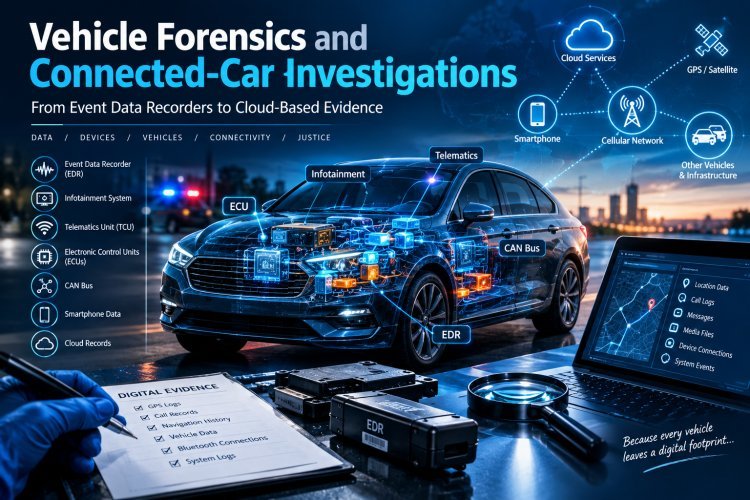
What is Vehicle Forensics?
Vehicle forensics is the scientific examination of physical and digital evidence associated with a vehicle to reconstruct events or establish relevant facts.
Traditional vehicle examination may involve:
- Paint
- Glass
- Tire marks
- Tool marks
- Blood/DNA
- Fingerprints
- Vehicle damage
- Vehicle identification numbers
Modern vehicle forensics adds another layer:
- Event Data Recorder (EDR)
- GPS/location information
- Infotainment data
- Bluetooth connections
- Call/contact information
- Navigation history
- Telematics records
- Electronic Control Units (ECUs)
- CAN-bus communications
- Diagnostic information
- Connected mobile-phone artifacts
- Cloud-based vehicle information

Research published in Forensic Science International: Digital Investigation describes modern vehicles as distributed digital evidence sources, with infotainment systems potentially containing GPS tracks, paired-device artifacts and information received from other vehicle modules.
What is a Connected Car?
A connected car is a vehicle capable of communicating with external devices, networks or services.
A modern connected vehicle can communicate with:
Vehicle ↔ Smartphone
Vehicle ↔ Cellular Network
Vehicle ↔ Manufacturer Cloud
Vehicle ↔ GPS Satellites
Vehicle ↔ Other Vehicles/Infrastructure
Vehicle ↔ Internet Services
This connectivity creates useful evidence—but it also creates additional privacy and cybersecurity considerations. NHTSA describes automotive cybersecurity as protecting vehicle electronic systems, communication networks, software, users and underlying data against unauthorized access, manipulation and other attacks.
Major Sources of Digital Evidence in a Vehicle
A forensic examiner should not think of the vehicle as having a single "black box."
Evidence may be distributed across several systems.

Important sources include:
1. Event Data Recorder — EDR
Primarily associated with crash-related information.
2. Infotainment System
May contain:
- Navigation destinations
- GPS-related information
- Paired Bluetooth devices
- Contacts
- Call records
- Media information
- Wi-Fi information
- User settings
3. Telematics Control Unit — TCU
May communicate vehicle information to external services through cellular networks.
4. Electronic Control Units — ECUs
Individual ECUs control different vehicle functions.
5. CAN Bus
Provides communication between vehicle electronic modules.
6. Smartphone
A connected phone can contain information that complements vehicle evidence.
7. Manufacturer Cloud
Depending on the vehicle and service, relevant information may also exist outside the vehicle.
Texas Department of Public Safety, for example, lists potential vehicle-forensic artifacts including Bluetooth/Wi-Fi identifiers, contacts, call logs, SMS/media artifacts, navigation, GPS tracklogs, vehicle events and driver-related alerts.
Event Data Recorder (EDR)
The Event Data Recorder (EDR) is one of the most important sources in crash-related vehicle forensics.
NHTSA defines an EDR as a device that records technical vehicle and occupant information for a short period around a crash event. Depending on the vehicle, information can include pre-crash vehicle dynamics, driver inputs, crash characteristics, restraint-system status and post-crash information.
Potential EDR information can include:
- Vehicle speed
- Accelerator position
- Brake application
- Steering-related information
- Change in velocity
- Seat-belt status
- Airbag deployment
- Restraint-system information
- Crash-event information
EDR data is not equivalent to a continuous video recording of the vehicle's entire journey. U.S. regulations specifically define EDR crash-event data separately from audio and video.
Why EDR Evidence is Important

Suppose investigators are examining a serious collision.
Witness statement:
"The vehicle was travelling slowly before the collision."
Physical evidence might suggest something different.
The examiner can potentially compare:
EDR data + vehicle damage + road evidence + CCTV + witness statements + other digital evidence
This helps investigators reconstruct the circumstances surrounding the collision.
NHTSA notes that EDR information can improve the accuracy of crash reconstruction.
Infotainment Forensics
The infotainment system can be particularly valuable because it may interact with:
- Navigation
- Bluetooth
- Smartphones
- Wi-Fi
- Media
- Voice systems
- Internet-connected services
- Vehicle functions
A 2025 peer-reviewed study examining Ford SYNC 3 infotainment forensics describes infotainment systems as an important source of digital artifacts, including GPS tracklogs and artifacts associated with paired mobile devices.
Potential evidence
| Artifact | Possible forensic relevance |
|---|---|
| Navigation history | Previous destinations |
| GPS information | Location/travel reconstruction |
| Bluetooth | Previously connected devices |
| Contacts | User/device associations |
| Call history | Communication timeline |
| Media | User activity |
| Wi-Fi | Network/device associations |
| Vehicle settings | User interaction |
The exact artifacts depend heavily on the vehicle model, software version and system configuration.
Telematics Forensics
Telematics combines telecommunications and vehicle information systems.
A telematics system may transmit information between the vehicle and a manufacturer's backend service.
Depending on the platform, telematics can potentially provide information related to:
- Vehicle location
- Vehicle status
- Driving events
- Remote commands
- Diagnostic information
- Emergency communications
- Connected-service activity
This creates an important forensic principle:
Evidence may exist inside the vehicle and outside the vehicle at the same time.
Therefore, investigators may need to correlate vehicle-side records with cloud-side records rather than examining only the physical car.
ECU Forensics

An Electronic Control Unit (ECU) is an electronic module responsible for controlling or monitoring particular vehicle functions.
A modern vehicle can contain many ECUs.
Examples include modules associated with:
- Engine
- Transmission
- Airbags
- Braking
- Steering
- Body control
- Infotainment
- Telematics
- Advanced driver-assistance systems
From a forensic perspective, ECUs can contain diagnostic information, configuration information, event-related information or other artifacts, depending on the module.
CAN Bus Forensics
The Controller Area Network (CAN) is a major communication network used by vehicle electronic systems.
Conceptually:
ECU A → CAN Bus → ECU B
ECU C → CAN Bus → ECU D
This allows different electronic modules to exchange information.
Forensic examination of CAN-related data may help investigators understand:
- Vehicle-system communications
- System states
- Diagnostic events
- Abnormal communications
- Potential cyberattack activity
CAN-bus evidence becomes particularly relevant when a vehicle is suspected of being involved in a cybersecurity incident or unauthorized manipulation.
Vehicle Cybersecurity and Forensics
Connected vehicles increase the attack surface.
Potential threats include:
- Unauthorized access
- Malicious software
- Compromised mobile applications
- Communication attacks
- Manipulation of vehicle systems
- Unauthorized remote commands
- Compromised connected services
NHTSA identifies protection of automotive electronic systems, communication networks, software, users and data as key elements of automotive cybersecurity.
The forensic question after a suspected attack becomes:
What happened?
When did it happen?
Which system was involved?
What evidence remains?
Was data altered?
Was a legitimate user or an unauthorized actor involved?
Vehicle Forensics in Criminal Investigations

Vehicle digital evidence can potentially assist investigations involving:
Hit-and-run
Vehicle movement and crash-related information may help reconstruct events.
Homicide investigations
Vehicle location, navigation and connected-device artifacts may contribute to a timeline.
Theft investigations
Connected-service and vehicle-system information may help establish vehicle movements or interactions.
Drug trafficking
Vehicle-related digital evidence can potentially complement physical and communication evidence.
Kidnapping investigations
Location-related records may become relevant when legally obtainable.
Insurance fraud
Digital vehicle evidence can be compared with statements and physical damage.
The U.S. Office of Justice Programs has described EDR evidence as potentially useful in investigations involving crashes and various criminal cases, while emphasizing challenges around acquisition and evidentiary reliability.
Accident Reconstruction
One of the most established applications is collision reconstruction.
Investigators can potentially combine:
EDR
Vehicle damage
Road evidence
CCTV
GPS/navigation
Witness statements
Smartphone evidence
This can help develop a timeline of the collision.
Importantly, no single digital artifact should automatically be treated as a complete reconstruction. The evidence should be evaluated alongside physical and independent sources.
Smartphone + Vehicle Forensics
This is a particularly interesting area.
When a smartphone connects to a vehicle, information may be exchanged between the two systems.
For example:
Smartphone
↓ Bluetooth / USB / Wi-Fi
Vehicle Infotainment
↓
Vehicle/Cloud Services
This may create multiple copies or representations of related information.
Investigators can potentially compare:
- Phone timestamps
- Vehicle timestamps
- GPS information
- Navigation history
- Bluetooth connection history
- Calls
- Messages
- Cloud records
This type of cross-source correlation can be extremely valuable when constructing a timeline.

Forensic Acquisition
Vehicle evidence should be handled carefully because some information can be volatile, overwritten or altered by subsequent interaction with the vehicle.
A simplified forensic workflow is:
           VEHICLE SEIZED / IDENTIFIED
                     ↓
             Legal Authorization
                     ↓
             Scene Documentation
                     ↓
            Preserve Vehicle State
                     ↓
        Identify Evidence Sources
                     ↓
      ┌──────────────┼──────────────┐
      ↓              ↓              ↓
     EDR       Infotainment      Telematics
      ↓              ↓              ↓
     ECU          CAN Data       Cloud Data
      └──────────────┼──────────────┘
                     ↓
             Evidence Extraction
                     ↓
             Integrity Verification
                     ↓
              Timeline Creation
                     ↓
               Interpretation
                     ↓
                Expert Report
Recent practical guidance emphasizes preservation, appropriate acquisition methods and cross-referencing timestamps among EDR, infotainment, telematics, phones and cloud records.
Maintaining Chain of Custody
As with other digital evidence, investigators need to document:
- Who collected the vehicle/evidence
- Date and time
- Location
- Vehicle identification
- Condition of vehicle
- Acquisition method
- Equipment/software used
- Data extracted
- Hashes where applicable
- Storage location
- Transfers between personnel
- Analysis performed
The goal is to demonstrate that the evidence was properly collected, preserved and analyzed.
Challenges in Vehicle Forensics

Vehicle forensics is powerful but technically difficult.
1. Encryption
Modern vehicles and connected services may use encryption or protected storage.
2. Proprietary systems
Different manufacturers use different architectures and data formats.
3. Distributed evidence
Evidence may be spread across:
Vehicle + Smartphone + Cloud + Manufacturer backend
4. Data volatility
Some information may change or be overwritten.
5. Legal and privacy issues
Vehicle data can reveal highly sensitive information about people's movements and interactions. Investigators therefore need appropriate legal authority and a clearly defined scope.
6. Tool limitations
Commercial forensic tools may not support every vehicle model or every artifact.
A 2026 study specifically evaluated proprietary "black-box" tools used in vehicle EDR and infotainment investigations and identified limitations involving coverage, reliability and tool output, highlighting the importance of validation and cross-checking.
Emerging Area: Autonomous Vehicle Forensics
As vehicles become increasingly automated, forensic investigators may eventually need to examine not only traditional vehicle data but also:
- Camera data
- LiDAR
- Radar
- ADAS logs
- AI decision-making information
- V2X communications
- Sensor states
- Automated driving-system events
- Cloud services
A 2026 study on forensic readiness for autonomous mobility proposes that future forensic systems may need to preserve information from sensors, AI decision-making, V2X communications, diagnostics and cloud services, with mechanisms for integrity, tamper detection and controlled access.
This is an important emerging research direction in forensic science.
Future of Vehicle Forensics
The future is likely to move toward integrated vehicle-digital investigations.
Instead of examining only the vehicle, investigators may correlate:
Vehicle
EDR + ECU + CAN + infotainment
Mobile
GPS + Bluetooth + calls + applications
Cloud
Telematics + connected services
External systems
CCTV + traffic cameras
Traditional evidence
DNA + fingerprints + trace evidence
The objective is to create a single evidence timeline from multiple independent sources.
Vehicle Forensics vs Traditional Vehicle Examination
| Traditional Vehicle Forensics | Digital Vehicle Forensics |
|---|---|
| Tire marks | GPS/location |
| Paint | Navigation history |
| Glass | Bluetooth artifacts |
| Vehicle damage | EDR data |
| Fingerprints | Infotainment data |
| DNA | Telematics |
| Mechanical examination | ECU data |
| Physical reconstruction | Digital timeline |
| Tool marks | CAN/diagnostic information |
Modern investigations increasingly require both approaches rather than replacing one with the other.
Follow cyberdeepakyadav.com on
Facebook, Twitter, LinkedIn, Instagram, and YouTube
What's Your Reaction?