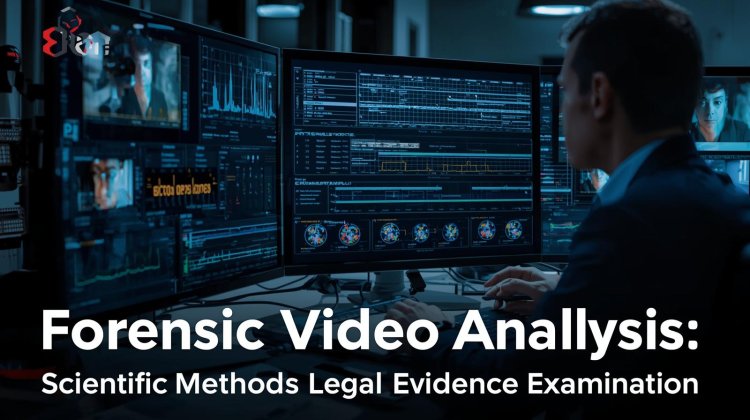
Forensic Video Analysis: Scientific Methods for Legal Evidence Examination
The scientific study, processing, and interpretation of video recordings for legal purposes is known as forensic video analysis. To extract trustworthy information from video evidence, it integrates digital signal processing, physics, optics, computer science, and investigative methodology.
The Nature of Video as Evidence
Video is a digital signal, not a continuous moving picture.
A video consists of:
-
Individual frames (images)
-
Frame rate (e.g., 30 fps)
-
Resolution (e.g., 1920×1080)
-
Compression format (H.264, H.265, MJPEG)
-
Bitrate
-
Metadata
-
Audio track (optional)
Because most surveillance systems compress video heavily, analysts must understand:
-
Lossy compression artifacts
-
Motion estimation
-
Interframe vs intraframe compression
-
GOP (Group of Pictures) structures
These factors affect what information can actually be recovered.
Core Areas of Forensic Video Analysis

A. Video Enhancement
Enhancement improves clarity without altering the underlying data.
Common Techniques
Brightness & Contrast Adjustment
-
Histogram equalization
-
Gamma correction
-
Dynamic range expansion
Noise Reduction
-
Temporal filtering
-
Spatial filtering
-
Median filters
-
Gaussian blur (carefully applied)
Sharpening
-
Edge enhancement
-
Unsharp masking
-
Deconvolution
Low-Light Enhancement
-
Signal amplification
-
Multi-frame stacking
-
Denoising algorithms
Stabilization
-
Motion vector correction
-
Frame alignment algorithms
Important principle:
Enhancement clarifies existing information — it cannot create new detail.
B. Authentication & Tampering Detection
Determining whether a video has been edited or manipulated.
Methods Used
1. Metadata Analysis
-
Creation date vs modification date
-
Device identification
-
Encoding history
2. Compression Analysis
-
Double compression artifacts
-
Bitrate inconsistencies
-
GOP structure irregularities
3. Frame-Level Examination
-
Missing frames
-
Duplicated frames
-
Sudden lighting shifts
-
Pixel-level inconsistencies
4. Error Level Analysis (ELA)
Detects recompression differences.
5. Deepfake Detection
-
Facial landmark inconsistency
-
Eye-blink irregularity
-
Head pose anomalies
-
GAN fingerprint detection

C. Photogrammetry (Measurement from Video)
One of the most powerful forensic techniques.
Used to measure:
-
Height of a suspect
-
Distance between objects
-
Speed of a vehicle
-
Trajectory paths
How It Works
Using:
-
Known reference objects
-
Camera calibration
-
Lens distortion correction
-
Perspective analysis
Example:
If a door frame is known to be 80 inches tall, analysts can compare pixel ratios to estimate a suspect’s height.
D. Image Comparison
This is not automatic facial recognition.
It involves:
-
Morphological comparison
-
Ear shape analysis
-
Scar or tattoo comparison
-
Clothing pattern comparison
-
Gait analysis
Analysts compare consistent anatomical features under controlled scaling conditions.
E. Speed Analysis
Used in:
-
Traffic accidents
-
Hit-and-run cases
-
Police pursuit investigations
Methods:
-
Frame counting
-
Time-distance calculations
-
Motion tracking
-
Perspective correction
Formula example:
Speed = Distance / Time
Time is calculated using frame rate.
F. Audio Forensics in Video
If audio exists:
-
Voice comparison
-
Gunshot timing analysis
-
Echo and reverberation study
-
Spectral analysis
-
Background noise profiling
The Scientific Foundations
Forensic video analysis relies on:
-
Digital signal processing (DSP)
-
Fourier transforms
-
Optics and lens distortion theory
-
Geometry & trigonometry
-
Statistical probability
-
Human perception research
It is not guesswork — conclusions must be measurable and reproducible.

Workflow of a Forensic Video Investigation
Step 1: Evidence Acquisition
-
Obtain original file (never a social media copy)
-
Preserve chain of custody
-
Create forensic duplicate
-
Hash verification (MD5, SHA256)
Step 2: Technical Assessment
-
Identify codec
-
Extract metadata
-
Determine compression level
-
Check frame integrity
Step 3: Clarification
-
Apply enhancement techniques
-
Export processed copies (never overwrite original)
Step 4: Analysis
-
Measure, compare, authenticate
-
Document every step
Step 5: Reporting
-
Write expert report
-
Include methodology
-
Explain limitations
-
Prepare courtroom exhibits
Tools Used Professionally
-
Amped FIVE
-
Cognitech Video Investigator
-
DVR Examiner
-
iNPUT-ACE
-
MATLAB / Python custom scripts
These tools are designed to preserve forensic integrity and document processing steps.

Why Forensic Video Analysis Is Critical Today
We live in a surveillance-heavy society:
-
Public CCTV
-
Ring doorbells
-
Dashcams
-
Bodycams
-
Smartphones
Video is now one of the most powerful forms of evidence — but only if analyzed correctly.
Follow cyberdeepakyadav.com on
Facebook, Twitter, LinkedIn, Instagram, and YouTube
What's Your Reaction?