LLM Forensics: Digital Investigation of Generative AI Systems
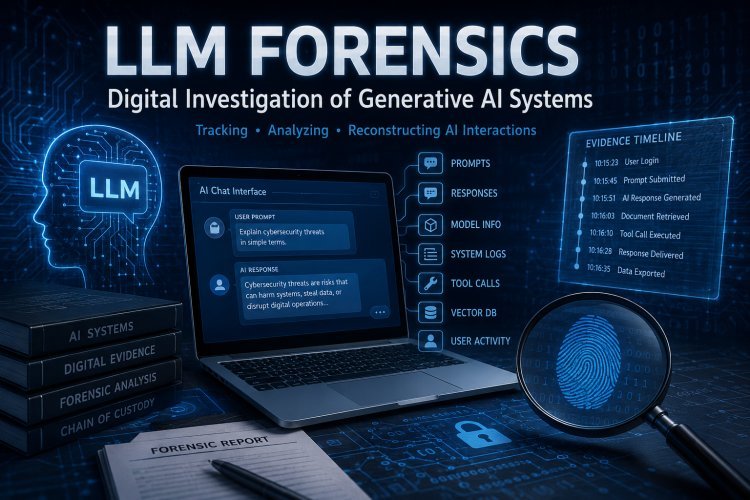
LLM Forensics is an emerging branch of digital forensics concerned with the identification, acquisition, preservation, examination, analysis, and interpretation of evidence associated with Large Language Models (LLMs) such as ChatGPT-style systems, enterprise AI assistants, coding copilots, and locally deployed open-source models. Unlike traditional computer forensics, where investigators primarily examine files, browser history, emails, logs, and deleted data, LLM forensics must also deal with prompts, generated responses, conversation histories, model interactions, system instructions, API logs, tool calls, embeddings, vector databases, and AI-generated content.
1. What is an LLM?
A Large Language Model (LLM) is an AI model trained on very large collections of text and other data to understand and generate human-like language.
Examples include systems based on models such as GPT, Claude, Gemini, Llama, and other commercial or open-source LLMs.
A simplified interaction looks like:
User → Prompt → LLM → Generated Response
But modern AI applications can be much more complicated:
User → Application → LLM → Retrieval System → Database → External Tool/API → LLM → Response
This creates many potential sources of digital evidence.
2. What is LLM Forensics?
LLM forensics is the forensic examination of digital artifacts generated, processed, stored, or transmitted during interactions with large language models.
The objective is to answer questions such as:
- Who interacted with the AI system?
- When did the interaction occur?
- What prompt was submitted?
- What response did the model generate?
- Was the response modified afterward?
- Which model/version generated it?
- What external tools did the AI system access?
- What documents were supplied to the model?
- Was confidential information entered into the AI?
- Was AI used to create fraudulent or malicious content?
- Can the origin of AI-generated content be established?
- Can investigators reconstruct the sequence of events?
3. Why LLM Forensics is Important
LLMs are increasingly being incorporated into:
- Cybersecurity
- Banking
- Healthcare
- Education
- Software development
- Customer service
- Government systems
- Legal services
- Social media
- Digital assistants
- Enterprise applications
At the same time, criminals can potentially use generative AI for:
- Phishing
- Social engineering
- Fraud
- Impersonation
- Malware development assistance
- Fake documents
- Disinformation
- Automated scams
- Credential theft campaigns
- Business email fraud
Therefore, investigators may increasingly encounter cases where AI itself is part of the evidence or part of the attack infrastructure.
4. LLM Forensics vs Traditional Digital Forensics
| Traditional Digital Forensics | LLM Forensics |
|---|---|
| Files | Prompts and conversations |
| Browser history | AI interaction history |
| Emails | AI-generated messages |
| System logs | AI/API interaction logs |
| Metadata | Model/version/session metadata |
| Deleted files | Deleted AI conversations/cache |
| Network packets | API requests and responses |
| Database records | Conversation/vector databases |
| User accounts | AI identities/API credentials |
| Malware artifacts | AI-generated code/instructions |
| File hashes | Content/model provenance mechanisms |
The major difference is that LLM evidence is often dynamic and context-dependent.
5. Major Sources of LLM Forensic Evidence
An investigator may need to examine several layers.
A. User Device
Evidence may exist on:
- Laptop
- Desktop
- Smartphone
- Tablet
- Browser
- AI application
- Local storage
- Cache
- Temporary files
Potential artifacts include:
- Conversation history
- Browser cache
- Cookies
- Local databases
- Downloaded files
- Uploaded documents
- Screenshots
- Clipboard artifacts
- Application logs
B. AI Application
The application connecting the user to the model can potentially contain:
- User ID
- Session ID
- Conversation ID
- Timestamps
- Prompt information
- Response information
- Uploaded attachments
- Model selection
- Application logs
These artifacts can help establish a timeline of AI usage.
C. Cloud/API Layer
When an LLM is accessed through an API, investigators may encounter:
- API request logs
- Authentication records
- Account information
- IP addresses
- Timestamps
- Token usage
- Model identifiers
- Request IDs
- Tool/API calls
- Error logs
Forensic acquisition from cloud providers must account for provider policies, legal authority, jurisdiction, and data-retention periods.
6. Prompt Forensics
One of the most important areas is prompt analysis.
A prompt is the input provided to an AI system.
For example:
"Write an email that looks like it came from a bank."
From a forensic perspective, investigators may ask:
- What exactly was entered?
- When was it entered?
- Which account submitted it?
- Which model processed it?
- Was the prompt edited?
- What response was generated?
- Was the output subsequently used?
Prompt sequences can sometimes reveal intent and workflow, although investigators should avoid treating a prompt alone as definitive proof of criminal intent.
7. Response Forensics
The generated response can itself become digital evidence.
Investigators may analyze:
- Generated text
- Code
- Structured output
- URLs
- Commands
- Recommendations
- Generated documents
- Metadata associated with the application
For example:
Prompt → AI-generated phishing email → copied → sent to victim
The forensic task is to establish the relationship between these events using independent evidence wherever possible.
8. Conversation Reconstruction
A major goal of LLM forensics is reconstructing the interaction timeline.
A hypothetical timeline might look like:
10:05:12  User logs into AI application
10:07:41  Document uploaded
10:08:05  Prompt submitted
10:08:09  AI generates response
10:10:31  User modifies generated text
10:12:17  Text copied to another application
10:15:44  Email created
10:16:02  Email sent
This timeline can be correlated with:
- Browser history
- Operating-system artifacts
- Email logs
- Network logs
- Cloud records
- Endpoint telemetry
This cross-source correlation is much stronger than relying on the AI conversation alone.
9. AI-Generated Content Forensics
LLMs can generate:
- Emails
- Articles
- Fake reviews
- Social-media posts
- Code
- Reports
- Messages
- Fake identities
- Scam scripts
Forensic investigators may need to determine:
Was this content generated or assisted by an AI system?
However, this is challenging.
Important point:
There is currently no universally reliable method for proving that a piece of ordinary text was generated by an LLM solely from the text itself.
AI detectors can produce false positives and false negatives.
Therefore, investigators should prefer:
- Original logs
- Conversation records
- Account records
- Application telemetry
- API logs
- File metadata
- Device artifacts
- Independent corroborating evidence
rather than relying solely on an "AI detector."
10. Model Attribution
Another challenging question is:
"Which AI model generated this output?"
Possible evidence may include:
- Model identifier
- API request
- Application logs
- Account records
- Configuration files
- Model metadata
- Local model files
- Provider-side records
For example:
Model: XYZ
Session: ABC123
Timestamp: 22:14:06
Prompt: ...
Response: ...
Model attribution becomes much easier when original system records are available.
11. System Prompts and Hidden Instructions
Modern LLM applications may have multiple instruction layers.
A simplified architecture can be:
System Instructions
        ↓
Developer Instructions
        ↓
User Prompt
        ↓
Retrieved Information
        ↓
Tools / APIs
        ↓
LLM
        ↓
Final Response
Forensic investigators may need to understand which instructions influenced the output.
This becomes particularly important when investigating:
- AI agents
- Enterprise copilots
- Autonomous systems
- Prompt injection incidents
- Data leakage
- Malicious AI applications
12. RAG Forensics
One of the most important modern concepts is Retrieval-Augmented Generation (RAG).
In RAG:
User Question
      ↓
Retriever
      ↓
Search Knowledge Base
      ↓
Relevant Documents
      ↓
LLM
      ↓
Answer
The model may not rely only on its pretrained knowledge. It may retrieve information from an organization's:
- PDFs
- Databases
- Internal documents
- Emails
- Knowledge bases
- Cloud storage
Why is this important for forensics?
Investigators may need to determine:
Which documents were retrieved and influenced the response?
This can involve examining:
- Vector databases
- Embeddings
- Retrieval logs
- Document IDs
- Chunk IDs
- Access logs
- Timestamps
- User permissions
13. Vector Database Forensics
RAG systems frequently use vector databases.
Documents are converted into numerical representations called embeddings.
Simplified process:
Document
   ↓
Text chunks
   ↓
Embedding model
   ↓
Vector representation
   ↓
Vector database
During investigation, relevant evidence can include:
- Original documents
- Document chunks
- Embeddings
- Metadata
- Collection IDs
- Access records
- Retrieval timestamps
Vector databases therefore represent a new forensic evidence source.
14. LLM API Forensics
Organizations often access models through APIs.
An API interaction might conceptually look like:
Application
     ↓
API Request
     ↓
LLM Provider
     ↓
Model Processing
     ↓
API Response
Investigators may examine:
- Request timestamps
- Authentication events
- API keys
- Model identifiers
- Request IDs
- Token consumption
- IP addresses
- Response records
- Error messages
Important: API keys and authentication credentials should be treated as sensitive evidence and handled according to proper forensic procedures.
15. Local LLM Forensics
Not all LLMs run in the cloud.
Some models can run locally on:
- Workstations
- Gaming PCs
- Servers
- Research systems
- Mobile/edge devices
Examples include locally deployed open-source models.
A forensic investigator may need to examine:
- Model files
- Configuration files
- Prompt histories
- Application databases
- Logs
- Cache
- GPU/CPU activity
- Download history
- Network connections
This introduces a major advantage:
More evidence may physically reside on the suspect device.
Follow cyberdeepakyadav.com on
Facebook, Twitter, LinkedIn, Instagram, and YouTube
What's Your Reaction?