Fake Scholarship Scam Explained | Jammu & Kashmir Police Cyber Advisory | Money Mule Fraud Awareness
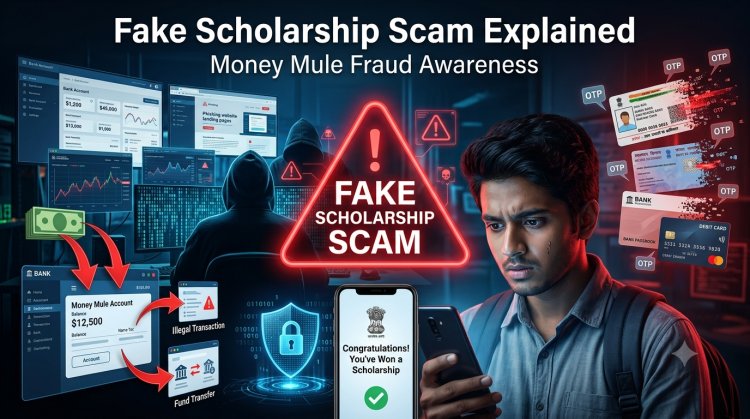
The Jammu & Kashmir Police has issued a public advisory warning citizens about Fake Scholarship Scams being used by cybercriminals to steal personal information, banking credentials, and recruit innocent individuals as Money Mules.
Cybersecurity Analysis: Fake Scholarship Scam – Jammu & Kashmir Police
Advisory
Introduction
The Jammu & Kashmir Police has issued an important public advisory warning citizens about the rapid rise of Fake Scholarship Scams being carried out by cybercriminals. These fraudsters exploit the financial needs of students and unemployed individuals by advertising fake scholarships, education grants, or financial assistance schemes. Their primary objective is to steal personal information, banking credentials, and recruit innocent people as Money Mules for illegal financial transactions.
This scam is a classic example of Social Engineering, where attackers manipulate human emotions such as trust, urgency, and financial need instead of exploiting technical vulnerabilities.
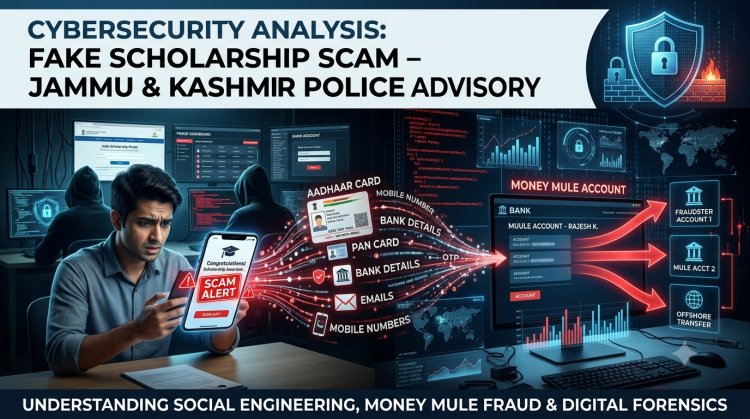
Attack Flow of the Fake Scholarship Scam
Fake Scholarship Advertisement
              │
              ▼
 Victim Clicks on Link
              │
              ▼
 Personal & Banking Details Collected
              │
              ▼
 Victim Opens/Provides Bank Account
              │
              ▼
 Account Used for Cyber Fraud
              │
              ▼
 Money Laundering & Illegal Transactions
              │
              ▼
 Financial Loss + Legal Consequences
How the Scam Works
Cybercriminals distribute fake scholarship advertisements through:
-
WhatsApp Messages
-
Telegram Channels
-
Facebook Posts
-
Instagram Ads
-
SMS
-
Emails
-
Fake Government Websites
Victims are promised:
-
???? Educational Scholarships
-
???? Financial Assistance
-
???? Tuition Fee Reimbursement
-
???? Government Student Grants
To receive these benefits, victims are asked to:
-
Fill online forms
-
Upload Aadhaar/PAN
-
Share bank account details
-
Enter OTPs
-
Open a new bank account
-
Submit KYC documents
Once this information is collected, criminals misuse it for cyber fraud.
Main Cybersecurity Concepts
| Keyword | Explanation |
|---|---|
| Social Engineering | Manipulating people into revealing confidential information. |
| Phishing | Fake links or websites used to steal information. |
| Identity Theft | Misuse of personal identity documents. |
| Money Mule | A person whose bank account is used to transfer illegal money. |
| Financial Fraud | Unauthorized transactions using stolen information. |
| Data Theft | Stealing personal and banking information. |
| Cyber Fraud | Fraud committed using digital technologies. |
What Information Do Criminals Target?
Personal Information
-
Aadhaar Number
-
PAN Card
-
Date of Birth
-
Address
-
Mobile Number
-
Email ID
Banking Information
-
Bank Account Number
-
IFSC Code
-
Debit Card Details
-
UPI ID
-
OTP
-
Internet Banking Credentials
Attack Lifecycle
Scammer Creates Fake Scholarship
                │
                ▼
Shares on Social Media & Messaging Apps
                │
                ▼
Victim Believes the Offer
                │
                ▼
Victim Shares Personal Information
                │
                ▼
Bank Account Created or Shared
                │
                ▼
Cybercriminal Uses Account
                │
                ▼
Illegal Money Transfer
                │
                ▼
Police Investigation Begins
Money Mule Explained
A Money Mule is an individual whose bank account is used to receive, transfer, or withdraw illegally obtained money.
Many victims unknowingly become money mules after:
-
Opening bank accounts for strangers
-
Renting out their bank account
-
Sharing ATM cards
-
Sharing internet banking credentials
Although they may not intend to commit a crime, they can still face:
-
Bank account freezing
-
Police questioning
-
Financial investigations
-
Legal proceedings
Digital Forensics Perspective
During an investigation, digital forensic experts examine:
-
???? Mobile Phones
-
???? Computers
-
???? Browser History
-
???? Emails
-
???? WhatsApp Chats
-
???? IP Address Logs
-
???? Banking Records
-
???? KYC Documents
-
???? Device Location Data
The objective is to identify:
-
The origin of the scam
-
Communication channels
-
Financial transaction trails
-
Digital evidence linking suspects to the crime

Warning Signs (Red Flags)
???? Scholarship offer received without applying.
???? Urgent request to claim money immediately.
???? Requests for OTP, PIN, or CVV.
???? Unknown links or QR codes.
???? Poorly designed government websites.
???? Requests to open a bank account for scholarship processing.
???? Promise of guaranteed approval.
Preventive Measures
✔ Verify scholarships only through official Government portals or recognized educational institutions.
✔ Never share:
-
OTP
-
ATM PIN
-
CVV
-
Internet Banking Password
✔ Do not click suspicious links.
✔ Never allow anyone to use your bank account.
✔ Enable two-factor authentication (2FA).
✔ Regularly monitor your bank statements.
✔ Keep your mobile device updated with the latest security patches.
Incident Response
If you suspect fraud:
-
Call 1930 immediately.
-
Report the incident on the National Cyber Crime Reporting Portal.
-
Inform your bank to block suspicious transactions.
-
Preserve screenshots, messages, emails, and transaction details as digital evidence.
Legal Implications
Victims whose bank accounts are misused may become part of cybercrime investigations. Relevant legal provisions can include:
-
Information Technology Act, 2000
-
Bharatiya Nyaya Sanhita (BNS) provisions related to cheating, identity fraud, and criminal conspiracy
-
Banking and anti-money laundering regulations, depending on the case
Key Cybersecurity Terms
-
Fake Scholarship Scam
-
Cyber Fraud
-
Social Engineering
-
Phishing
-
Money Mule
-
Identity Theft
-
Data Breach
-
Financial Fraud
-
Digital Forensics
-
Cyber Awareness
-
Online Scam
-
Banking Fraud
-
KYC Fraud
-
OTP Fraud
-
Incident Response
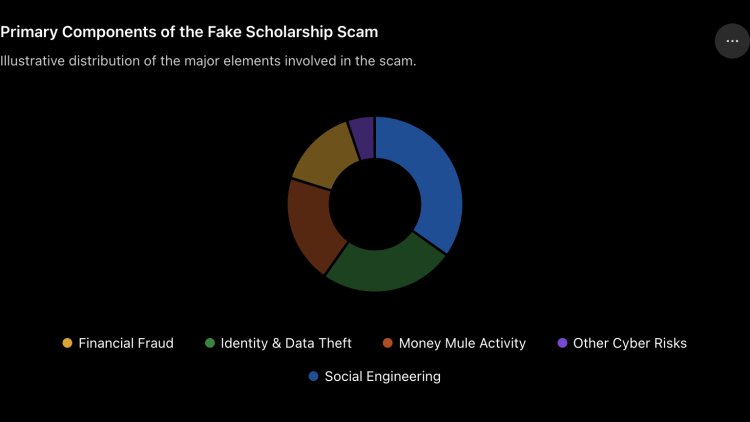
Cybersecurity Threat Distribution
Primary Components of the Fake Scholarship Scam
Illustrative distribution of the major elements involved in the scam.
Conclusion
The Fake Scholarship Scam is a rapidly growing form of cyber-enabled financial fraud that targets students and job seekers by exploiting their trust and financial needs. Through social engineering, attackers obtain sensitive personal and banking information, recruit victims as money mules, and facilitate illegal financial transactions. Public awareness, verification of scholarship offers through official sources, and timely reporting to 1930 are essential to prevent financial losses and support effective cybercrime investigations.
Follow cyberdeepakyadav.com on
Facebook, Twitter, LinkedIn, Instagram, and YouTube
What's Your Reaction?