Post-Quantum Cryptography (PQC)
Post-Quantum Cryptography (PQC) refers to cryptographic algorithms designed to be secure against quantum computers.
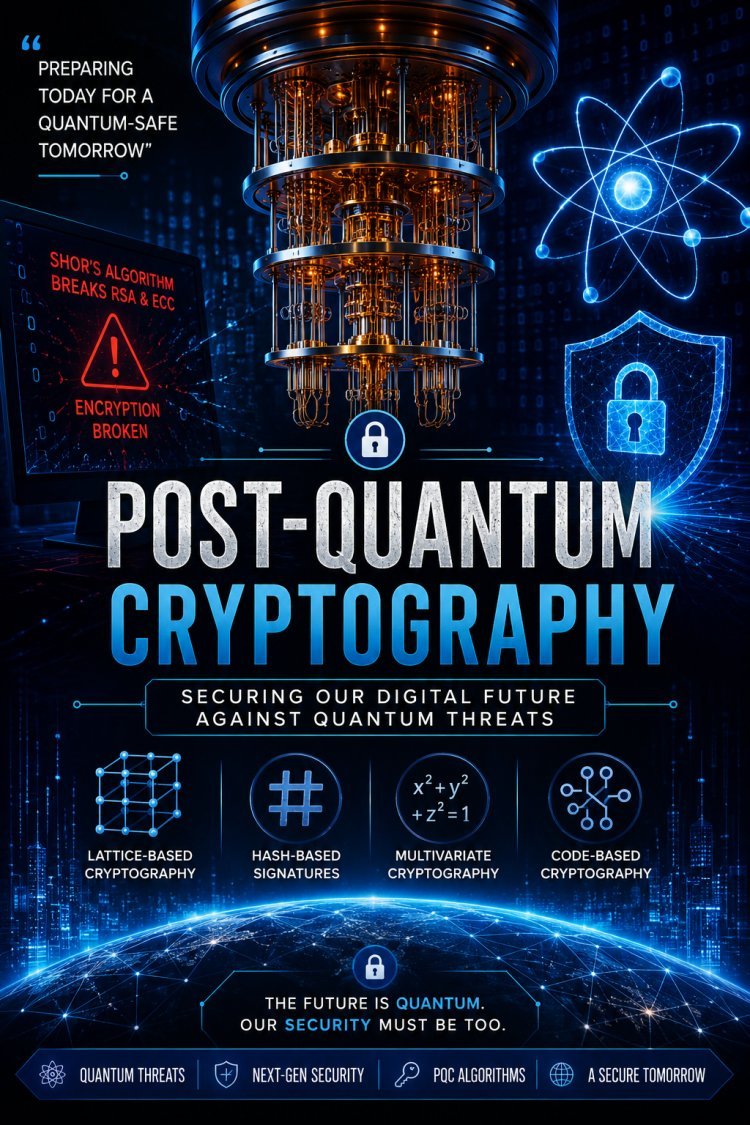
Today’s encryption (like RSA, ECC) is secure against classical computers
But quantum computers can break them using advanced algorithms
Why is PQC Needed?
Problem:
- Classical encryption depends on:
- Integer factorization (RSA)
- Discrete logarithm (ECC)
- These problems are hard for classical computers
But Quantum Computers can:
- Use Shor’s Algorithm
- Break RSA/ECC in minutes or hours
Major Threat:
“Harvest Now, Decrypt Later” Attack
- Attackers steal encrypted data today
- Wait for quantum computers
- Decrypt in the future

How Quantum Computers Break Encryption
Key Concepts:
- Qubits → can exist in multiple states (superposition)
- Entanglement → faster computation
- Parallel processing → huge speed advantage
Important Algorithms:
- Shor’s Algorithm
- Breaks RSA, ECC
- Grover’s Algorithm
- Speeds up brute-force attacks
- Reduces symmetric key security (e.g., AES-128 → behaves like AES-64)
What is Post-Quantum Cryptography Based On?

PQC uses mathematical problems that even quantum computers cannot easily solve
Main PQC Approaches:
| Method | Description |
|---|---|
| Lattice-Based | Most popular (used in Kyber, Dilithium) |
| Hash-Based | Based on hash functions (very secure) |
| Multivariate | Polynomial equations |
| Code-Based | Error-correcting codes (McEliece) |
NIST Standard PQC Algorithms (Important)

???????? NIST Selected Algorithms:
| Purpose | Algorithm |
|---|---|
| Encryption | CRYSTALS-Kyber |
| Digital Signature | CRYSTALS-Dilithium |
| Alternative Signature | Falcon |
| Hash-Based Signature | SPHINCS+ |
How PQC Works (Simple Flow)

Steps:
- Sender encrypts data using PQC public key
- Data travels securely over network
- Receiver decrypts using PQC private key
Even quantum computers cannot break it easily
PQC vs Classical Cryptography
| Feature | Classical Crypto | PQC |
|---|---|---|
| Security | Broken by quantum | Quantum-resistant |
| Algorithms | RSA, ECC | Kyber, Dilithium |
| Speed | Fast | Slightly slower |
| Key Size | Small | Larger keys |
These are becoming global standards for future security
Real-World Applications

- Banking & Financial Systems
- Cloud Security
- Secure Messaging Apps
- Military Communication
- IoT Devices
Challenges of PQC
- Large key sizes
- Performance overhead
- Compatibility with old systems
- Migration complexity
Future of PQC

- Governments & companies already migrating
- Hybrid cryptography (Classical + PQC)
- Quantum-safe internet in future
Conclusion
Post-Quantum Cryptography is not optional anymore — it is the future of cybersecurity
Protects against upcoming quantum threats
Ensures long-term data security
Critical for digital forensics, banking, defense
Follow cyberdeepakyadav.com on
Facebook, Twitter, LinkedIn, Instagram, and YouTube
What's Your Reaction?