API Security & API Attacks
An API (Application Programming Interface) is a set of rules that allows different software applications to communicate with each other. APIs are widely used in: Mobile apps Web applications Cloud services IoT devices For example: When you log in using Google on a website, an API connects that website with Google’s servers.
What is API Security?
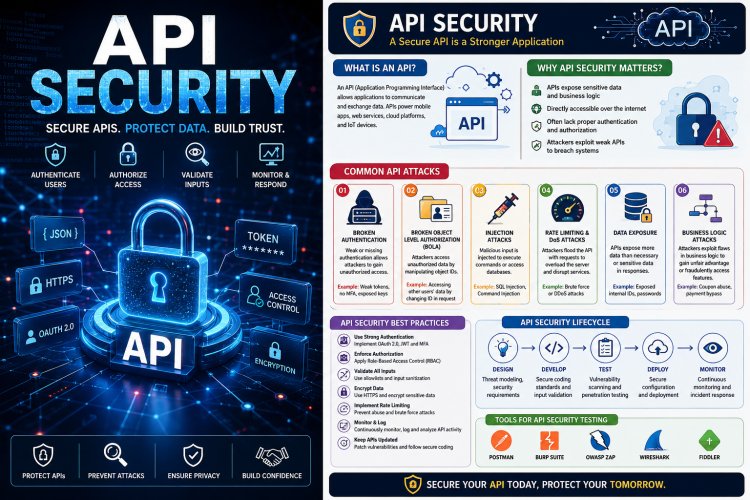
API Security refers to the protection of APIs from unauthorized access, misuse, and attacks. Since APIs expose sensitive data and business logic, they are a prime target for attackers.
Why APIs Are Vulnerable?
- Direct exposure to the internet
- Improper authentication mechanisms
- Lack of input validation
- Misconfigured access controls
- Rapid development without security testing

Common API Attacks
1. Broken Authentication Attack
Occurs when authentication mechanisms are weak or improperly implemented.
Example:
- Weak passwords
- Tokens not expiring
- No MFA (Multi-Factor Authentication)
Prevention:
- Use strong authentication (OAuth 2.0, JWT)
- Implement MFA
- Use secure token storage
2. Broken Object Level Authorization (BOLA)
Attackers manipulate object IDs to access unauthorized data.
Example:
Changing:
Attackers manipulate object IDs to access unauthorized data.
???? Example:
Changing:
/api/user/123 → /api/user/124to access another user's data.
Prevention:
- Implement proper authorization checks
- Use indirect object references
- Validate user permissions
to access another user's data

3. Injection Attacks (SQL/Command Injection)
Malicious input is injected into API requests to execute unintended commands.
Example:
username=admin' OR '1'='1Prevention:
- Input validation & sanitization
- Use prepared statements
- Avoid dynamic queries
4. Rate Limiting & DoS Attack
Attackers send massive requests to overload the API server.
Example:
- Bot sending thousands of requests per second
Prevention:
- Implement rate limiting
- Use API gateways
- Deploy WAF (Web Application Firewall)
5. Data Exposure Attack
APIs return excessive or sensitive data unnecessarily.
Example:
- Returning password hashes or internal data in response
Prevention:
- Filter response data
- Encrypt sensitive data
- Follow least privilege principle
6. Business Logic Attacks
Attackers exploit flaws in application logic.
Example:
- Applying unlimited discount coupons
- Skipping payment verification
Prevention:
- Thorough testing of workflows
- Implement logic validation checks

Tools Used in API Security Testing
Testing Tools:
- Postman – API testing
- Burp Suite – Intercept & modify API traffic
- OWASP ZAP – Automated vulnerability scanning
- Wireshark – Network analysis
- Fiddler – HTTP debugging
API Security Best Practices

Authentication & Authorization
- Use OAuth 2.0, JWT
- Implement role-based access control (RBAC)
Input Validation
- Validate all inputs
- Use allowlists instead of blocklists
Encryption
- Use HTTPS (TLS)
- Encrypt sensitive data
Rate Limiting
- Prevent abuse & brute force attacks
Logging & Monitoring
- Monitor API usage
- Detect anomalies
Follow cyberdeepakyadav.com on
Facebook, Twitter, LinkedIn, Instagram, and YouTube
What's Your Reaction?