Ahmedabad Cyber Fraud: Businessman Allegedly Loses ₹2.33 Lakh From 3 Bank Accounts
An Ahmedabad businessman allegedly lost ₹2.33 lakh across three HDFC Bank accounts after his phone became unresponsive during a software update. Police are investigating seven unauthorised transactions.

Ahmedabad Businessman Allegedly Loses ₹2.33 Lakh
From Three
Bank Accounts After Phone Freezes During Software
Update
Ahmedabad, Gujarat: An Ahmedabad businessman has allegedly lost ₹2,33,331 from three bank accounts following an incident in which his mobile phone reportedly became unresponsive during an unexpected software update. The case has raised concerns about the potential financial risks when multiple banking relationships are connected to a single smartphone or registered mobile number.
According to the complaint, Kuldip Rajendrakumar Sharma, a businessman from Shahibaug, discovered that seven unauthorised transactions had been carried out from three HDFC Bank accounts on October 24. The affected accounts included his business current account, personal account and an account belonging to his daughter.
Shahibaug police have registered a case and are investigating how the transactions were executed, how access to the banking services was obtained, and whether the handset was compromised.
Seven Unauthorised Transactions Reportedly Affect Three Accounts
According to the complaint, Sharma's mobile phone unexpectedly began displaying what appeared to be a software update on October 24. During the process, the handset reportedly became unresponsive, preventing him from using it normally.
Soon afterwards, funds were allegedly withdrawn from bank accounts linked to the same mobile number.
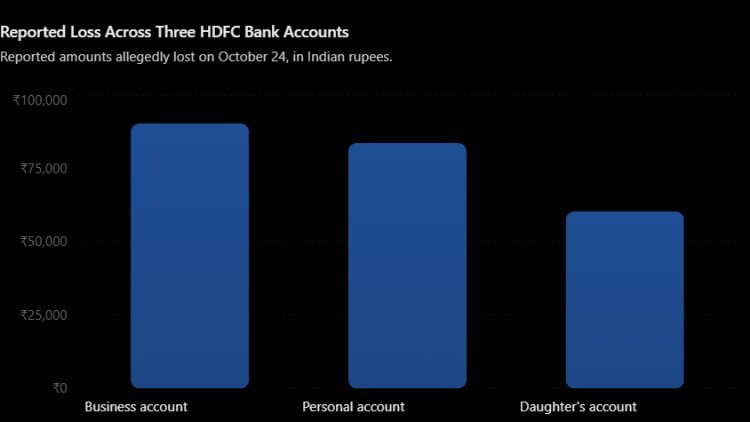
The reported losses were ₹89,999 from the business current account, ₹83,332 from the personal account and ₹60,000 from his daughter's account. The seven transactions resulted in a combined reported loss of ₹2,33,331.
Account-Wise Breakdown of the Reported Loss
| Affected account | Reported amount lost |
|---|---|
| Business current account | ₹89,999 |
| Personal bank account | ₹83,332 |
| Daughter's bank account | ₹60,000 |
| Total | ₹2,33,331 |
The business current account recorded the largest reported loss, followed by the personal account and the daughter's account. The incident affected both business and household finances.
A Single Device May Have Increased the Exposure
The case highlights a potential security concern associated with using one smartphone to manage several financial accounts.
Mobile devices are frequently used for banking applications, payment services, transaction notifications and authentication. When multiple accounts rely on the same handset or registered number, a compromise affecting that device could increase the risk of unauthorised access across more than one account.
However, sharing a mobile number does not, by itself, establish that accounts can be accessed together. Investigators must determine whether the alleged transactions resulted from compromised applications, stolen credentials, unauthorised device access, misuse of authentication mechanisms or another method.
In this case, the reported involvement of a business account, a personal account and a family member's account makes it important to establish whether the transactions shared a common technical or financial connection.
Was the Software Update Linked to the Fraud?
The timing of the incident raises questions about whether the apparent software update was connected to the alleged fraud. A malicious application, remote-access tool or compromised banking credentials are among the possible avenues investigators may examine.
Nevertheless, the available account does not establish that the update itself was malicious or that malware was responsible for the withdrawals. A phone becoming unresponsive can have several causes, and the sequence of events alone does not prove a cyberattack method.
A technical examination of the handset, including installed applications, relevant permissions, device activity and available security logs, could help investigators establish what happened. Banking records, transaction authentication details, beneficiary accounts and the timing of the transfers may also help reconstruct the incident.
Financial Trail Could Be Crucial to the Investigation
The seven reported transactions may provide investigators with important leads about how the money was transferred and who ultimately received it.
Examining beneficiary accounts and subsequent fund movements could help establish whether the money was routed through a common destination or distributed among multiple accounts. Investigators may also examine available banking and device records to identify suspicious activity associated with the period in question.
The exact transaction route, the identity of any suspected perpetrators and the recovery status of the funds have not been established in the supplied account of the incident.
What Smartphone Users Can Learn From the Case
The reported incident underlines the importance of treating unexpected device behaviour and unexplained banking activity as potential security concerns.
Users should install software updates through official device settings or trusted manufacturer channels and avoid installing applications from unknown links. They should also review app permissions and avoid granting unnecessary access to accessibility services, notifications or remote-control functions.
If a phone becomes unresponsive and suspicious financial activity is detected, users should check all linked accounts, contact the relevant banks immediately and request appropriate protective measures. In India, suspected financial cyber fraud can be reported through the national cybercrime helpline at 1930 or the official National Cyber Crime Reporting Portal.
Investigation Continues
Shahibaug police are investigating the circumstances surrounding the seven transactions and the alleged loss of ₹2,33,331. Establishing how the handset behaved during the incident, how the banking transactions were authenticated and where the money was transferred will be central to determining the sequence of events.
The case serves as a reminder that when several financial services depend on one digital device, suspicious activity affecting that device warrants prompt attention across all connected accounts. The precise cause of the incident, however, will depend on the findings of the investigation.
The Ahmedabad incident highlights the importance of mobile device security in an increasingly digital banking environment. While investigators work to establish how the alleged fraud occurred, users are advised to remain alert to unexpected changes in device behaviour and promptly report suspicious transactions. Any suspected cyber financial fraud should be reported to the concerned bank and India’s cybercrime helpline at 1930. The exact method used in this case remains subject to investigation.
Follow cyberdeepakyadav.com on
Facebook, Twitter, LinkedIn, Instagram, and YouTube
What's Your Reaction?