Drug Detection in Forensic Science
Drug detection in forensic science is the scientific process of identifying, analyzing, and quantifying drugs, poisons, intoxicants, and their metabolites in biological and physical evidence. It is a major component of Forensic Toxicology and is widely used in criminal investigations, medico-legal cases, anti-doping analysis, and public health monitoring.
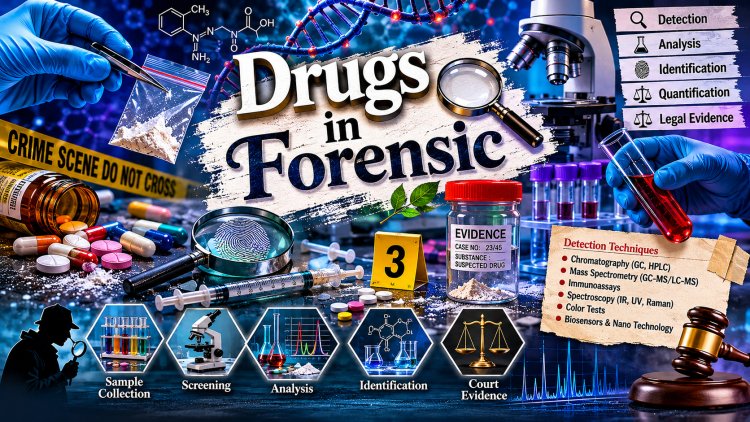
The discipline combines:
- Analytical chemistry
- Toxicology
- Pharmacology
- Molecular biology
- Instrumental analysis
The primary objective is to establish whether a drug or toxic substance was present, in what quantity, and whether it contributed to impairment, poisoning, or death.
Classification of Drugs Commonly Detected
1. Narcotic Drugs
These depress the central nervous system and may cause addiction.
Examples:
- Heroin
- Morphine
- Opium
- Fentanyl
2. Stimulants
These increase alertness and brain activity.
Examples:
- Cocaine
- Methamphetamine
- Amphetamine
- MDMA (Ecstasy)
3. Depressants
These reduce nervous system activity.
Examples:
- Benzodiazepines
- Barbiturates
- Alcohol
4. Hallucinogens
These alter perception and consciousness.
Examples:
- LSD
- Psilocybin
- Ketamine
5. Cannabis and Cannabinoids
Examples:
- Marijuana
- Hashish
- THC products
6. New Psychoactive Substances (NPS)
These are synthetic designer drugs created to mimic illegal drugs.
Examples:
- Synthetic cannabinoids
- Bath salts
- Synthetic opioids
NPS detection is one of the most difficult modern forensic challenges because chemical structures change rapidly.

Role of Drug Detection in Forensic Investigations
Drug analysis is essential in:
| Area | Purpose |
|---|---|
| Criminal cases | Identification of seized narcotics |
| Postmortem toxicology | Determination of cause of death |
| Doping control | Detection of performance-enhancing drugs |
| DUI investigations | Detection of intoxication |
| Workplace testing | Identification of drug abuse |
| Drug-facilitated crimes | Detection of sedatives in victims |
Types of Samples Used in Drug Detection
Biological Samples
Blood
- Best indicator of current intoxication
- Used in DUI and poisoning cases
Advantages:
- Reflects active drug concentration
Limitations:
- Invasive collection
- Short detection window
Urine
Most commonly used screening sample.
Advantages:
- Easy collection
- High metabolite concentration
Limitations:
- Indicates past exposure rather than impairment
Hair
Useful for long-term drug history.
Detection window:
- Weeks to months
Applications:
- Chronic drug abuse investigations
Saliva (Oral Fluid)
Useful for recent drug use.
Applications:
- Roadside testing
- Workplace testing
Tissue and Organ Samples
Used mainly in autopsy toxicology.
Examples:
- Liver
- Kidney
- Brain tissue

Steps in Forensic Drug Detection
1. Evidence Collection
The sample is carefully collected while maintaining:
- Chain of custody
- Sterility
- Proper labeling
- Preservation conditions
Improper handling may invalidate evidence in court.
2. Screening Tests
Initial rapid tests identify possible drug classes.
These tests are:
- Fast
- Cost-effective
- Presumptive, not confirmatory
Examples:
- Color tests
- Immunoassays
3. Confirmatory Tests
More sophisticated methods confirm drug identity with high specificity.
These are legally admissible methods.
4. Quantitative Analysis
Determines:
- Drug concentration
- Toxic level
- Therapeutic level
- Fatal level

Important Analytical Techniques
1. Chromatography
Chromatography is the backbone of forensic drug analysis.
It separates components in complex mixtures.
A. Thin Layer Chromatography (TLC)
Principle
Compounds move at different speeds on a stationary surface.
Uses
- Preliminary drug identification
- Screening unknown powders
Advantages
- Cheap
- Simple
- Rapid
Limitations
- Lower sensitivity
- Less accurate

B. Gas Chromatography (GC)
Principle
Volatile substances separate in a gas phase.
Applications
- Drugs
- Alcohol analysis
- Volatile poisons
C. High-Performance Liquid Chromatography (HPLC)
Principle
Separation occurs in liquid mobile phase under high pressure.
Applications
- Non-volatile drugs
- Pharmaceutical analysis
Advantages:
- Highly sensitive
- Accurate quantification
2. Mass Spectrometry (MS)
Mass Spectrometry identifies molecules based on mass-to-charge ratio.
GC-MS (Gold Standard)
Combination of:
- Gas chromatography
- Mass spectrometry
Applications:
- Cocaine detection
- Heroin confirmation
- Toxicological investigations
Advantages:
- Extremely accurate
- Highly sensitive
- Court-admissible
LC-MS/MS
Used for:
- Modern synthetic drugs
- Thermally unstable compounds
Widely used in:
- Clinical toxicology
- Anti-doping laboratories

3. Immunoassays
Based on antigen-antibody interaction.
Examples:
- ELISA
- EMIT
- Fluorescence immunoassay
Applications:
- Rapid urine screening
- Workplace testing
Advantages:
- Fast
- Automated
Limitations:
- False positives possible
4. Spectroscopic Techniques
Infrared Spectroscopy (IR)
Detects molecular vibrations.
Applications:
- Identification of unknown powders
Raman Spectroscopy
Useful for:
- Portable drug detection
- Non-destructive analysis
Widely used at:
- Airports
- Border security
5. Color and Spot Tests
Simple chemical reactions producing characteristic colors.
Examples:
| Test | Drug Detected |
|---|---|
| Marquis test | Opiates, amphetamines |
| Scott test | Cocaine |
| Duquenois-Levine test | Cannabis |
Limitations:
- Non-specific
- False reactions possible

Emerging Technologies in Drug Detection
1. Portable Drug Detection Devices
Handheld instruments provide on-site analysis.
Examples:
- Portable Raman spectrometers
- Handheld FTIR devices
Applications:
- Crime scenes
- Customs inspection
2. Biosensors
Use biological molecules to detect drugs rapidly.
Advantages:
- Very sensitive
- Rapid response
- Small sample requirement
3. Nanotechnology
Nanoparticles improve:
- Sensitivity
- Detection limits
- Miniaturization
Applications:
- Trace drug residue detection
4. Artificial Intelligence (AI)
AI systems assist in:
- Pattern recognition
- Automated toxicology reports
- Drug trend analysis
AI is increasingly used in forensic laboratories for high-throughput screening.

Drug Metabolism and Metabolite Detection
Many drugs are metabolized in the body before excretion.
Therefore forensic scientists often detect metabolites instead of parent drugs.
Examples:
| Drug | Important Metabolite |
|---|---|
| Heroin | 6-MAM |
| Cocaine | Benzoylecgonine |
| Cannabis | THC-COOH |
Postmortem Toxicology
In death investigations, forensic toxicologists determine:
- Cause of death
- Drug overdose
- Poisoning
- Mixed-drug interactions
Challenges include:
- Postmortem redistribution
- Decomposition
- Drug instability
Interpretation of Drug Levels
Drug concentration interpretation is complex because effects depend on:
- Age
- Tolerance
- Body weight
- Route of administration
- Drug interactions
Therefore toxicological findings must always correlate with clinical and investigative evidence.

Current Challenges
1. Designer Drugs
Rapidly changing chemical structures make detection difficult.
2. Deep Web Drug Markets
Cryptocurrency and encrypted networks complicate investigations.
3. Microdose Detection
Modern drugs may be active at extremely low concentrations.
4. Laboratory Backlogs
Increasing case loads delay toxicology reporting.
What's Your Reaction?