Deepfake Detection and Multimedia Forensics
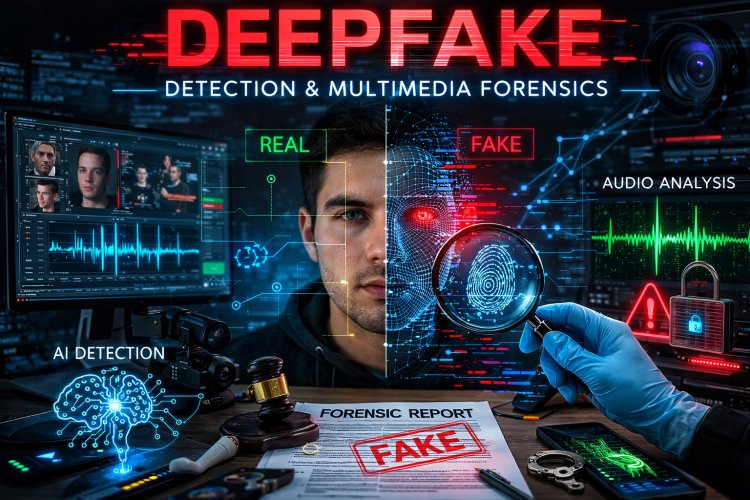
Deepfake Detection and Multimedia Forensics is a field of digital forensics that focuses on identifying manipulated or fake multimedia content such as images, videos, and audio created using artificial intelligence (AI). Deepfakes use deep learning algorithms, especially Generative Adversarial Networks (GANs), to generate highly realistic fake media that can replace faces, voices, or entire scenes. This area of forensics aims to detect, analyze, and verify the authenticity of multimedia evidence to prevent misinformation, fraud, and cybercrime.
1. What is a Deepfake?
A deepfake is a type of synthetic media created using AI-based deep learning techniques that manipulate or generate realistic images, videos, or audio.
The word “deepfake” comes from:
-
Deep Learning
-
Fake Media
Deepfakes can:
-
Replace a person’s face in a video
-
Imitate someone’s voice
-
Create fake speeches
-
Alter images realistically
Example:
A video showing a person saying something they never actually said.
2. What is Multimedia Forensics?
Multimedia Forensics is the scientific analysis of multimedia data to determine:
-
Authenticity of images, videos, and audio
-
Source of media
-
Evidence of manipulation or tampering
-
Timeline of creation
It helps investigators determine whether media content is genuine or altered.
Types of multimedia examined:
-
Digital images
-
Videos
-
Audio recordings
-
Social media media files
-
Surveillance footage

3. Technologies Used to Create Deepfakes
1. Generative Adversarial Networks (GANs)
GANs consist of two neural networks:
Generator
-
Creates fake images or videos
Discriminator
-
Detects whether the content is real or fake
These two networks compete, improving the realism of the fake content.
2. Autoencoders
Autoencoders are neural networks used to learn facial features and recreate them in another video.
They are commonly used in face swapping.
3. Face Swapping Algorithms
These algorithms replace a person’s face with another face in a video using AI-based mapping.
4. Voice Cloning
AI models can replicate a person's voice by analyzing small voice samples.
This allows criminals to generate fake audio messages or calls.
4. Types of Deepfakes
Face Replacement
Replacing a person's face with another face in a video.
Facial Expression Manipulation
Changing facial expressions while keeping the same identity.
Voice Deepfakes
Creating synthetic audio that mimics someone's voice.
Full Body Deepfakes
Generating entire fake videos of people performing actions.
5. Why Deepfake Detection is Important
Deepfakes pose serious risks:
Misinformation
Fake political speeches or news videos.
Identity Theft
Impersonating individuals for fraud.
Cybercrime
Fake voice calls for financial scams.
Reputation Damage
Fake videos used for harassment or defamation.
Legal Evidence Tampering
Fake videos used in court cases.
Deepfake detection ensures trust in digital media and legal evidence.

6. Deepfake Detection Techniques
1. Visual Artifact Detection
Deepfake videos often contain visual inconsistencies such as:
-
Unnatural blinking
-
Distorted facial edges
-
Lighting inconsistencies
-
Blurry regions
Investigators analyze these artifacts.
2. Facial Landmark Analysis
Algorithms analyze facial landmarks such as:
-
Eye movement
-
Lip synchronization
-
Head movement
Deepfake models sometimes fail to reproduce natural human behavior.
3. Frequency Domain Analysis
Fake images often leave patterns in the frequency spectrum.
Forensic tools analyze image frequency patterns to detect manipulation.
4. Biological Signal Detection
Real videos contain natural signals like:
-
Heartbeat changes in skin color
-
Micro facial movements
Deepfakes may fail to replicate these signals accurately.
5. AI-Based Detection
Machine learning models are trained to distinguish between real and fake media.
Common algorithms:
-
Convolutional Neural Networks (CNN)
-
Deep neural networks
-
Transformer-based models
7. Multimedia Forensics Investigation Process
Step 1: Evidence Collection
Collect the image, video, or audio file.
Step 2: Metadata Analysis
Check file metadata such as:
-
Creation date
-
Device information
-
Software used
Step 3: Content Analysis
Analyze:
-
Visual artifacts
-
Compression patterns
-
Pixel inconsistencies
Step 4: AI Detection
Use deep learning models to detect deepfake characteristics.
Step 5: Reporting
Document the findings in a forensic report.
8. Tools Used in Deepfake and Multimedia Forensics
Common tools include:
| Tool | Purpose |
|---|---|
| Deepware Scanner | Detect deepfake videos |
| Sensity AI | Deepfake detection platform |
| Forensically | Image forensic analysis |
| Amped Authenticate | Image authentication |
| Video Authenticator | Video integrity verification |

9. Challenges in Deepfake Detection
Rapidly Improving AI
Deepfake technology is improving faster than detection methods.
High Quality Deepfakes
Modern deepfakes are extremely realistic.
Lack of Detection Standards
No universal standards for deepfake verification.
Large Data Volume
Huge amount of multimedia content online makes detection difficult.
10. Real World Applications
Law Enforcement
Detect fake evidence in criminal investigations.
Social Media Platforms
Identify manipulated content.
Journalism
Verify authenticity of news media.
National Security
Detect propaganda and misinformation.
Cybersecurity
Prevent AI-based fraud and scams.
Follow cyberdeepakyadav.com on
Facebook, Twitter, LinkedIn, Instagram, and YouTube
What's Your Reaction?