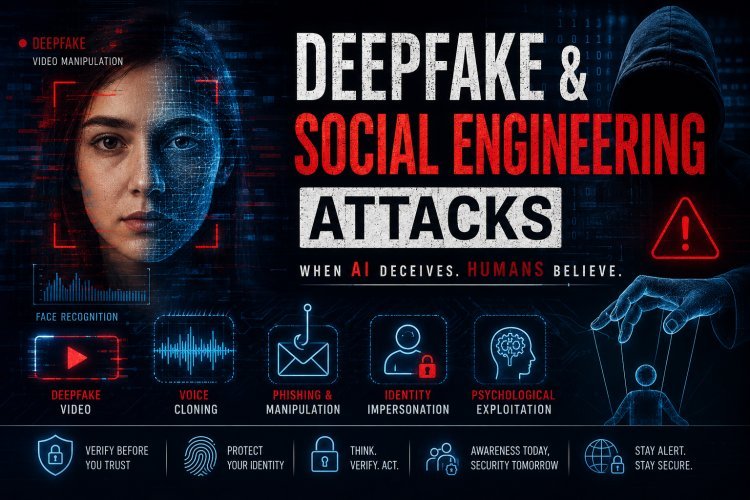
Deepfake & Social Engineering Attacks
Deepfakes are AI-generated fake videos, images, or audio that look and sound real. Created using Deep Learning (GANs – Generative Adversarial Networks) Can mimic a person’s face, voice, expressions, and behavior
-
Deepfake Technology — Technical Breakdown
Core Technology Behind Deepfakes
1. Generative Adversarial Networks (GANs)
- Two neural networks:
- Generator → creates fake data
- Discriminator → detects if fake or real
- Both compete → result = highly realistic fake output
Over time, generator becomes so strong that fake = indistinguishable from real
2. Autoencoders (Face Swapping)
- Encode face → compress into features
- Decode → reconstruct target face
- Swap identity while preserving expressions
3. Diffusion Models (Latest Trend)
- Used in modern AI tools
- Generate hyper-realistic images/videos step-by-step

Deepfake Creation Pipeline:
- Data Collection (images, videos, voice samples)
- Data Preprocessing (alignment, cleaning)
- Model Training (GAN/Autoencoder)
- Face/Voice Synthesis
- Post-processing (enhancement, lip-sync correction)
2. Audio Deepfake (Voice Cloning) — Technical View

How Voice Cloning Works:
- Uses Text-to-Speech (TTS) + Voice Conversion Models
- Requires:
- 3–10 seconds of voice (modern tools)
- Generates:
- Tone, pitch, accent, emotion
Key Models:
- Tacotron / WaveNet
- VITS (latest neural TTS)
- Speaker embedding models
Why Audio Deepfake is More Dangerous:
- No need for video
- Works via phone calls (vishing)
- Harder to detect than video
3. Social Engineering — Psychological Exploitation

Core Human Weakness Exploited:
| Principle | Explanation |
|---|---|
| Authority | “I am your boss” |
| Urgency | “Do it now!” |
| Fear | “Your account will be blocked” |
| Curiosity | “Click to see…” |
| Trust | Known person impersonation |
Attackers design attacks based on human behavior, not system flaws
4. Full Attack Lifecycle (Deepfake + Social Engineering)

Step-by-Step Attack Flow:
Phase 1: Reconnaissance
- Collect data from:
- Social media (LinkedIn, Instagram)
- Public speeches, YouTube videos
- Data leaks
Phase 2: Profiling
- Identify:
- Target role (CEO, finance officer)
- Communication style
- Voice patterns
Phase 3: Deepfake Creation
- Train model on collected data
- Generate fake voice/video
Phase 4: Delivery (Social Engineering)
- Email / WhatsApp / Zoom call
- Impersonate authority
Phase 5: Exploitation
- Ask for:
- Money transfer
- OTP
- Confidential data
Phase 6: Exit
- Delete traces
- Move funds via crypto / mule accounts
5. Deepfake Detection — Forensic Level Analysis

A. Visual Forensics
- Frame-by-frame analysis
- Facial landmark mismatch
- Lighting inconsistency
- Shadow anomalies
B. Audio Forensics
- Spectrogram analysis
- Frequency inconsistencies
- Lack of natural breathing patterns
C. AI-Based Detection
- CNN models trained on fake vs real
- Detect pixel-level anomalies
Advanced Tools:
- Amped Authenticate
- Deepware Scanner
- Reality Defender
- Intel FakeCatcher
Technical Challenges in Investigation

- High-quality deepfakes = hard to detect
- Encrypted communication (WhatsApp, Telegram)
- Attribution problem (who created it?)
- Cross-border cybercrime
Prevention Framework

- Zero Trust Architecture
- Multi-factor authentication (MFA)
- Employee awareness training
- Verification protocols (call-back verification)
Individual Level:
- Never trust urgent requests blindly
- Verify identity via secondary channel
- Avoid oversharing personal media
- Enable security alerts
Legal & Ethical Aspects
Laws Applicable:
- IT Act 2000 (Sections 66, 66D – impersonation, fraud)
- IPC Sections (cheating, identity theft)
Future Trends

- AI vs AI (attack vs defense)
- Real-time deepfake detection tools
- Digital watermarking (content authenticity)
- Stronger regulations coming
Follow cyberdeepakyadav.com on
Facebook, Twitter, LinkedIn, Instagram, and YouTube
What's Your Reaction?