Next-Generation Sequencing (NGS)
Forensic Biology and Next-Generation Sequencing together represent one of the most transformative developments in modern forensic laboratory science. NGS, also called Massively Parallel Sequencing (MPS), enables simultaneous sequencing of millions of DNA fragments, providing far more genetic information than conventional forensic DNA typing methods.
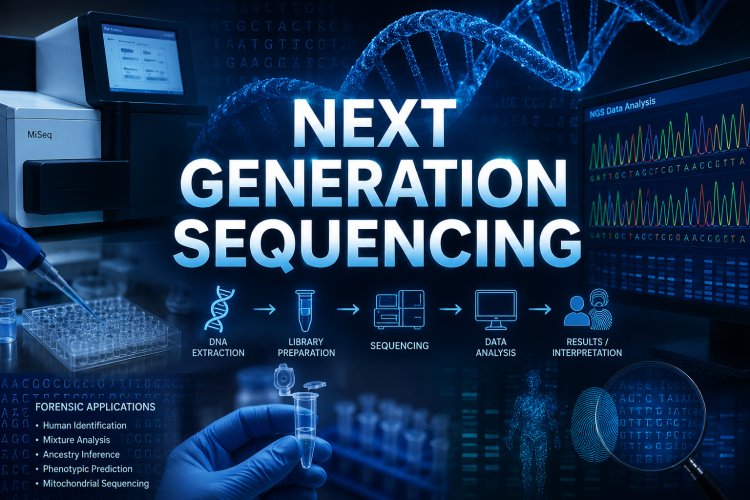
Background: From STR Profiling to NGS
Traditional Forensic DNA Analysis
Conventional forensic DNA typing mainly relies on:
- Short Tandem Repeat (STR) analysis
- Capillary electrophoresis (CE)
- PCR amplification of selected loci
This approach is highly effective but has limitations:
- Difficulty interpreting mixed DNA samples
- Limited discrimination in degraded samples
- Inability to extract ancestry or phenotypic information
- Reduced sensitivity for low-template DNA
Emergence of NGS
NGS overcomes many of these limitations by sequencing DNA at the nucleotide level rather than only measuring fragment size.
Core Principle
Instead of analyzing one DNA region at a time, NGS can:
- Sequence hundreds to thousands of loci simultaneously
- Detect sequence variation within STRs
- Analyze SNPs, mtDNA, and epigenetic markers together
2. What Makes NGS Important in Forensic Laboratories?
Key Advantages
| Feature | Traditional STR | NGS |
|---|---|---|
| Number of markers analyzed | Limited | Very high |
| Mixture interpretation | Moderate | Improved |
| Degraded DNA analysis | Limited | Better |
| Sequence-level information | No | Yes |
| SNP analysis | Limited | Extensive |
| Phenotype prediction | No | Possible |
| Ancestry inference | Minimal | Advanced |
3. Major Applications of NGS in Forensic Biology
A. Human Identification
NGS enhances individual identification by analyzing:
- STRs
- SNPs
- InDels
- mtDNA simultaneously
Laboratory Significance
Useful in:
- Criminal investigations
- Missing persons cases
- Mass disasters
- Human trafficking investigations
B. Complex DNA Mixture Interpretation
One of the biggest forensic challenges is mixed DNA profiles.
NGS Advantage
Sequence-level data can differentiate alleles having identical lengths but different nucleotide sequences.
This greatly improves:
- Contributor separation
- Statistical interpretation
- Minor contributor detection
Research Area
Development of probabilistic genotyping algorithms for NGS datasets.
C. Degraded and Low-Copy DNA Analysis
NGS is highly useful for:
- Burned remains
- Skeletal remains
- Ancient biological samples
- Highly degraded crime scene evidence
Why?
NGS can target very short DNA fragments (“mini-amplicons”), improving recovery from damaged samples.

D. Forensic Phenotyping
NGS can predict externally visible characteristics (EVCs):
- Eye color
- Hair color
- Skin pigmentation
- Facial morphology (emerging)
Example
DNA from an unknown suspect may generate investigative leads regarding physical appearance.
Ethical Concern
Potential privacy and discrimination issues.
E. Ancestry and Biogeographical Origin
SNP panels analyzed by NGS can estimate:
- Continental ancestry
- Population affinity
- Migration lineage
This is useful in unidentified human remains cases.
F. Mitochondrial Genome Sequencing
Traditional mtDNA typing analyzes only hypervariable regions.
NGS permits:
- Whole mitochondrial genome sequencing
- Higher discrimination power
- Better maternal lineage analysis
Particularly useful in hair shaft and skeletal analysis.
G. Forensic Epigenetics
An emerging field involving epigenetic biomarkers.
Applications
NGS can analyze DNA methylation patterns for:
- Age estimation
- Tissue source identification
- Lifestyle prediction (experimental)
Current Research
Biological age prediction models using methylation markers.
4. Workflow of NGS in a Forensic Laboratory
Step 1: Sample Collection
Biological evidence:
- Blood
- Saliva
- Hair
- Semen
- Bone
- Touch DNA
Step 2: DNA Extraction
Standard forensic extraction methods:
- Organic extraction
- Chelex extraction
- Silica-based purification
Step 3: Library Preparation
A crucial NGS step.
Includes
- DNA fragmentation
- Adapter ligation
- Barcode/index attachment
- Amplification
Each sample receives a unique barcode.
Step 4: Sequencing
Common forensic NGS platforms:
| Platform | Company |
|---|---|
| MiSeq FGx | Illumina |
| Ion Torrent | Thermo Fisher Scientific |
| Oxford Nanopore | Oxford Nanopore Technologies |
Step 5: Bioinformatics Analysis
This is one of the most important laboratory challenges.
Tasks Include
- Sequence alignment
- Variant calling
- STR interpretation
- SNP analysis
- Statistical calculations
Emerging Need
Dedicated forensic bioinformatics pipelines.
Step 6: Interpretation and Reporting
Laboratories must validate:
- Accuracy
- Reproducibility
- Sensitivity
- Contamination thresholds
before courtroom implementation.

5. Emerging Research Areas in NGS Forensic Biology
A. AI-Assisted NGS Interpretation
Machine learning for:
- Mixture deconvolution
- Sequence classification
- Error correction
B. Portable Sequencing
Devices like portable nanopore sequencers may enable:
- Crime scene sequencing
- Field-based disaster victim identification
C. Single-Cell Forensics
Analyzing DNA from individual cells in mixtures.
A highly advanced future direction.
D. Multi-Omics Forensics
Combining:
- Genomics
- Transcriptomics
- Proteomics
- Metabolomics
for comprehensive forensic profiling.

6. Challenges in Forensic Laboratories
Technical Challenges
- High instrument cost
- Complex data interpretation
- Large data storage requirements
- Need for specialized bioinformatics expertise
Validation Challenges
Forensic methods require strict validation:
- ISO/IEC 17025 compliance
- SWGDAM guidelines
- Reproducibility studies
Legal and Ethical Issues
Major Concerns
- Genetic privacy
- Population bias
- Predictive phenotyping ethics
- Database misuse
Courts require transparency and scientific reliability.
7. Important Bioinformatics in NGS Forensics
Common Analytical Areas
- FASTQ data processing
- Variant calling
- Alignment algorithms
- STR sequence analysis
- Bayesian statistical interpretation
Relevant Software
- STRait Razor
- ExactID
- EuroForMix
- GeneMapper (hybrid workflows)
Bioinformatics is becoming central to forensic laboratory operations.

8. NGS vs Traditional STR Typing
| Parameter | STR-CE | NGS |
|---|---|---|
| Resolution | Fragment length | Full sequence |
| Throughput | Moderate | Very high |
| Mixture analysis | Limited | Improved |
| SNP capability | Minimal | Extensive |
| mtDNA sequencing | Partial | Whole genome possible |
| Data complexity | Lower | Very high |
| Cost | Lower | Higher |
9. Future of NGS in Forensic Laboratories
The future forensic laboratory may include:
- Automated sequencing pipelines
- AI-assisted interpretation
- Cloud-based forensic databases
- Portable sequencing systems
- Real-time DNA analysis
NGS is expected to gradually complement and potentially replace many conventional forensic DNA methods.
Follow cyberdeepakyadav.com on
Facebook, Twitter, LinkedIn, Instagram, and YouTube
What's Your Reaction?