Environmental Forensics
Environmental forensics asks: What pollutant is present, where did it come from, how did it get there, when did it happen, and who or what may be responsible?
1. What is Environmental Forensics?
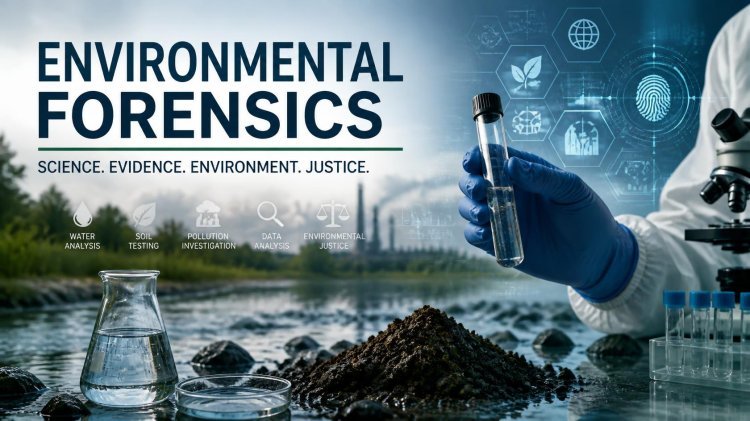
Environmental Forensics is the application of forensic science, chemistry, biology, geology, toxicology, environmental science and analytical techniques to investigate environmental contamination, identify its source, determine how it occurred, assess its impact, and provide scientifically defensible evidence for legal or regulatory action.
Environmental forensic investigations can involve soil, groundwater, surface water, sediments, air, plants, animals and industrial materials. Modern environmental crime-scene investigation increasingly combines field sampling, laboratory analysis, source tracing, spatial analysis and reconstruction of the pollution event.
2. Why is Environmental Forensics Important?
Environmental pollution is not always accidental. It may result from:
- Illegal dumping of hazardous waste
- Industrial discharge
- Oil or chemical spills
- Illegal mining
- Improper disposal of toxic chemicals
- Sewage discharge
- Agricultural chemical contamination
- Groundwater contamination
- Illegal waste-burning
- Wildlife poisoning
- Deliberate environmental damage
The forensic objective is not simply to prove "pollution exists."
Investigators need to establish a connection between:
Pollution → Source → Pathway → Impact → Responsible activity/person
This makes environmental forensics particularly important when an environmental incident becomes a criminal investigation, regulatory matter, civil dispute or environmental litigation.

3. Major Areas of Environmental Forensics
A. Soil Forensics
Soil can preserve chemical, mineralogical, biological and physical information.
Investigators may examine:
- Soil composition
- Heavy metals
- Petroleum hydrocarbons
- Pesticides
- Industrial chemicals
- Minerals
- Organic matter
- Microorganisms
- Man-made particles
Soil can help determine whether contamination at two locations is consistent with the same source. Soil is also important in conventional forensic investigations because soil can transfer between shoes, vehicles, clothing, tools and locations.
4. Water Forensics
Water forensics investigates contamination of:
- Rivers
- Lakes
- Ponds
- Groundwater
- Drinking-water sources
- Wetlands
- Coastal environments
Investigators may look for:
Chemical contaminants
- Heavy metals
- Petroleum products
- Pesticides
- Solvents
- Industrial chemicals
- PFAS and other emerging contaminants
Physical parameters
- pH
- Temperature
- Electrical conductivity
- Dissolved oxygen
- Turbidity
These parameters can provide early indications of contamination and help investigators understand the environmental conditions. INTERPOL's pollution-crime investigation guidance, for example, recommends documenting sampling locations and considering parameters such as pH, dissolved oxygen, temperature and conductivity in appropriate water investigations

5. Air Pollution Forensics
Environmental forensic scientists can investigate suspected releases into the atmosphere.
Potential evidence includes:
- Particulate matter
- Volatile organic compounds
- Industrial gases
- Combustion products
- Chemical emissions
- Smoke residues
Investigators may compare samples collected around an affected area with material from a suspected source.
For example:
Factory emission → atmospheric dispersion → surrounding contamination
Scientific analysis can help determine whether the chemical signature is consistent with a particular source.
6. Sediment Forensics
Sediments at the bottom of rivers, lakes and coastal areas can act as a historical record of contamination.
Scientists can examine:
- Heavy metals
- Hydrocarbons
- Pesticides
- Industrial chemicals
- Organic contaminants
- Microplastics
Different layers may provide information about the history and distribution of contamination.
7. Environmental Toxicology
Environmental toxicology examines how chemicals affect:
- Humans
- Animals
- Plants
- Aquatic organisms
- Soil organisms
- Ecosystems
Forensic toxicology may be particularly important when investigators find dead fish, birds, livestock or wildlife near a suspected pollution source.
The investigation may ask: Was the death caused by a toxic substance, and can that substance be connected to a particular environmental source?

8. Major Types of Evidence
Environmental forensic evidence can be divided into several categories.
| Evidence | What it can help determine |
|---|---|
| Soil | Contamination and geographical/source relationships |
| Water | Pollutants and contamination pathways |
| Sediment | Historical contamination |
| Air | Atmospheric pollutants and emissions |
| Plants | Uptake or exposure to contaminants |
| Fish/wildlife | Toxic exposure and ecological impact |
| Industrial waste | Possible source of contamination |
| Chemical residues | Chemical fingerprint |
| Containers/drums | Possible origin of waste |
| Documents | Waste disposal and industrial records |
| Satellite imagery | Spatial and temporal changes |
| GPS/GIS data | Distribution and movement of contamination |
9. Environmental Crime Scene Investigation
Environmental crime scenes are different from conventional crime scenes.
Instead of a single room or location, contamination may extend over kilometres.
A typical investigation can involve:
Step 1 — Scene recognition
Investigators identify:
- Suspected pollution
- Dead vegetation
- Dead animals
- Unusual colour or odour
- Chemical residues
- Waste containers
- Discharge points
- Industrial activity
Step 2 — Documentation
Investigators record:
- Photographs
- Videos
- GPS coordinates
- Maps
- Weather conditions
- Nearby industries
- Drainage systems
- Water flow
- Physical observations
Step 3 — Identify possible sources
Potential sources could include:
Factory → Drain → River
or
Waste dump → Soil → Groundwater → River
Step 4 — Sampling
Samples may be collected from:
- Suspected source
- Contaminated location
- Upstream location
- Downstream location
- Background/control location
- Groundwater
- Soil
- Sediment
INTERPOL guidance emphasizes documenting sample locations and obtaining source/background/impact samples so that contamination can be compared and traced

10. Chain of Custody
Just like traditional forensic evidence, environmental samples require proper chain of custody.
It documents:
Who collected the sample → When → Where → How → How it was packaged → Who transported it → Who received it → How it was analyzed
This is extremely important because environmental samples may later become evidence in court.
Important information includes:
- Sample identification number
- Date and time
- Location/GPS
- Collector
- Sample type
- Container
- Preservation method
- Seal information
- Transportation conditions
- Laboratory receipt
- Analytical method
Improper sampling or contamination can compromise the evidential value of an otherwise excellent laboratory result.
11. Laboratory Analysis
After collection, samples may undergo multiple analytical techniques.
A. Chromatography
Used to separate and identify chemical compounds.
Examples:
- GC — Gas Chromatography
- HPLC — High-Performance Liquid Chromatography
- GC-MS — Gas Chromatography–Mass Spectrometry
- LC-MS/MS — Liquid Chromatography–Tandem Mass Spectrometry
B. Spectroscopy
Examples:
- FTIR
- UV-Visible spectroscopy
- Raman spectroscopy
- Atomic absorption spectroscopy
C. Elemental analysis
Used for metals and elements such as:
- Lead
- Mercury
- Arsenic
- Cadmium
- Chromium
- Copper
Techniques can include:
- AAS
- ICP-OES
- ICP-MS
- XRF
D. Microscopy
Useful for:
- Soil particles
- Fibres
- Minerals
- Industrial particles
- Biological material

12. Chemical Fingerprinting
One of the most interesting concepts in environmental forensics is chemical fingerprinting.
Different sources can have different chemical compositions.
For example:
Oil sample from suspected factory
⬇️
Oil contaminant in river
⬇️
Scientists compare their chemical profiles.
If the profiles show strong compatibility, the evidence may support a source relationship.
However, scientists must consider alternative sources, environmental degradation, mixtures and background contamination rather than assuming that a chemical match automatically proves responsibility.
Environmental forensic work therefore often combines chemical analysis with spatial, temporal and contextual evidence.
13. Pollution Pathway Reconstruction
This is another important concept.
Suppose investigators find contamination in groundwater.
They may reconstruct:
Industrial waste
⬇️
Contaminated soil
⬇️
Chemical migration
⬇️
Groundwater
⬇️
River
This is called contaminant pathway reconstruction.
Pollutants can move through soil and groundwater and eventually reach surface water; understanding this pathway is essential when reconstructing pollution events
14. Source Attribution
The central question can be:
"Where did the contamination come from?"
Scientists may compare:
Source sample
with
Environmental sample
using:
- Chemical composition
- Elemental composition
- Isotopic signatures
- Organic compounds
- Mineral characteristics
- Spatial distribution
- Historical information
Source attribution is usually strongest when multiple independent lines of evidence converge.

15. GIS and Satellite Technology
Modern environmental investigations increasingly use:
GIS
Geographic Information Systems can map:
- Pollution concentrations
- Sampling points
- Industrial facilities
- Rivers
- Groundwater
- Waste-disposal locations
- Contamination boundaries
Satellite imagery
Satellite data can help identify:
- Illegal dumping
- Deforestation
- Mining
- Changes in water bodies
- Large-scale pollution
- Land-use changes
Recent ecological crime-scene approaches specifically highlight the integration of satellite analysis, environmental sampling, DNA identification and chemical tracing
16. Role of DNA and Biological Evidence
Biological evidence can also contribute to environmental investigations.
Examples include:
- Environmental DNA (eDNA)
- Microbial communities
- Plant DNA
- Animal DNA
- Species identification
For example, eDNA collected from water can help determine whether particular organisms are present in an ecosystem.
This can be useful in investigations involving:
- Wildlife crime
- Illegal fishing
- Biodiversity loss
- Environmental damage

17. Emerging Technology in Environmental Forensics
This is where the field becomes particularly interesting for a 2026 forensic science article.
Artificial Intelligence
AI can assist with:
- Pollution-pattern recognition
- Satellite-image analysis
- Anomaly detection
- Spatial prediction
- Large environmental datasets
- Source classification
Remote sensing
Useful for large-scale environmental crime scenes.
Portable analytical instruments
Field-portable instruments can allow investigators to obtain rapid chemical information before or alongside laboratory confirmation. Research on the evolution of environmental forensics specifically identifies field-portable instrumentation as an important development.
eDNA
Can provide biological evidence from environmental samples.
Advanced mass spectrometry
Useful for detecting contaminants at very low concentrations and characterizing complex chemical mixtures.
Follow cyberdeepakyadav.com on
Facebook, Twitter, LinkedIn, Instagram, and YouTube
What's Your Reaction?