UPI & Digital Payment Fraud Forensics
Absolutely. UPI & Digital Payment Fraud Forensics is an excellent contemporary cyber-forensics topic, especially for an India-focused article or research paper. Modern investigations increasingly involve UPI IDs, bank accounts, mule accounts, mobile devices, merchant accounts, fintech platforms, and transaction trails
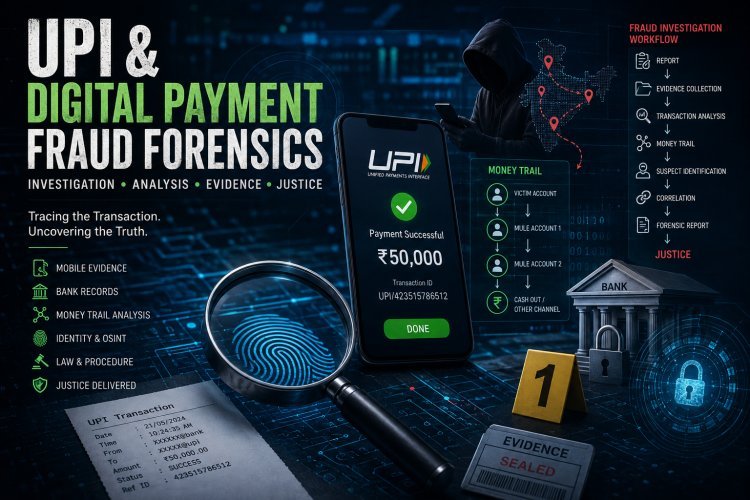
UPI & Digital Payment Fraud Forensics
1. What is UPI?
UPI (Unified Payments Interface) is an instant payment system that enables users to transfer money between bank accounts through a mobile application using identifiers such as a UPI ID, mobile number, QR code, or other supported payment mechanisms.
The important forensic point is that a UPI transaction is not just a payment on a phone. It can generate evidence across multiple systems:
Victim's device → UPI/payment app → PSP/bank → NPCI infrastructure → beneficiary bank → beneficiary account/device
Therefore, investigating a UPI fraud often requires correlating evidence from several sources.
2. What is Digital Payment Fraud Forensics?
Digital Payment Fraud Forensics is the systematic collection, preservation, examination, analysis and presentation of digital evidence associated with fraudulent financial transactions.
It combines:
- Digital forensics
- Mobile forensics
- Banking transaction analysis
- Network/log analysis
- OSINT
- Financial intelligence
- Cybercrime investigation
- Evidence preservation
- Timeline reconstruction
Who initiated the transaction, from which device/account, through which application or infrastructure, where did the money go, and who ultimately controlled the receiving account?
3. Why UPI Fraud Investigation Is Different
Traditional financial investigation may primarily focus on:
Account → Transaction → Beneficiary
A cyber-forensic investigation can go much deeper:
Victim → Phone → SIM → UPI application → Device identifiers → Authentication event → Transaction → UPI ID → Bank account → Mule account → Subsequent transfers → Cash withdrawal/crypto conversion → Suspect
This makes digital evidence correlation extremely important.
NPCI's fraud-related procedures demonstrate the importance of transaction details, investigation reports and relevant logs in payment-fraud investigations.
4. Major Types of UPI & Digital Payment Fraud
A. UPI Phishing
The victim receives a fake:
- Bank message
- KYC notification
- Refund message
- Account-blocking warning
- Customer-care message
- Payment request
The attacker attempts to obtain credentials or convince the victim to perform a transaction.
Forensic evidence
Investigators may examine:
- SMS
- WhatsApp/Telegram messages
- URLs
- Browser history
- Call logs
- Screenshots
- Payment-app records
- Device artifacts
- Bank transaction records
5. Fake Customer-Care Fraud
A victim searches for customer support online and contacts a fraudulent number.
The fraudster may convince the victim to:
- Install a remote-access application
- Share sensitive information
- Approve a payment
- Enter a UPI PIN
- Scan a QR code
- Perform a "verification" transaction
Investigation
Investigators should correlate:
Search history → fake website/social-media profile → phone number → communication → remote-access activity → transaction → beneficiary account
This is a good example of why mobile + OSINT + financial forensics need to work together.
6. QR-Code Fraud
QR codes themselves are not inherently fraudulent, but criminals can manipulate the payment process by presenting a QR code that directs money to an unintended recipient.
Evidence can include:
- QR image
- QR-generation source where available
- UPI ID encoded in QR
- Messages containing the QR
- Website/page hosting the QR
- Transaction ID
- Recipient account
- Device/application evidence
A forensic examiner should preserve the original QR image rather than relying only on a screenshot.
7. UPI Collect/Payment-Request Fraud
A fraudster may send a payment request while misleading the victim about its purpose.
The investigator should determine:
- Who initiated the request?
- Which UPI ID was involved?
- When was it generated?
- What was the amount?
- What message/remark accompanied it?
- Did the victim knowingly authorize it?
- What device was used?
- Where did the funds go afterward?
8. SIM-Swap & Account-Takeover Fraud
This is particularly important in digital-payment investigations.
A criminal may compromise a victim's mobile-number control and subsequently attempt to access financial services.
Investigators may examine:
Telecom evidence
- SIM replacement records
- SIM activation/deactivation
- Subscriber details
- Cell-site information obtained lawfully
- Device/IMEI associations
- Relevant call/SMS records
Banking evidence
- Login records
- Authentication events
- Device registration
- Transaction records
- Beneficiary additions
- Account changes
The objective is to establish whether the victim's normal device/SIM activity changed around the time of the fraud.
9. Social Engineering Payment Fraud
In many cases, the technology isn't "hacked."
Instead, the victim is manipulated into authorizing the transaction.
Examples include:
- Fake investment schemes
- Fake job offers
- Fake police/government calls
- Fake delivery refunds
- Fake KYC updates
- Fake loan applications
- Fake customer support
- Romance/investment scams
From a forensic perspective, communication evidence becomes extremely important.
10. Mule Account Fraud
This is one of the most important concepts for financial cybercrime investigation.
A money mule is an account used to receive or move illicit funds on behalf of another person or group.
RBI specifically warns against allowing others to use one's bank account to receive or transfer money.
A simplified flow can look like:
Victim → Mule Account 1 → Mule Account 2 → Mule Account 3 → Cash/other financial channel
The investigator therefore shouldn't stop after identifying the first beneficiary account.
11. Transaction Laundering / Layering
Criminals may rapidly move stolen funds through several accounts.
For example:
₹50,000 stolen
↓
Account A
↓
Account B
↓
Account C
↓
Wallet/merchant/other financial channel
The investigator performs transaction-chain analysis to identify:
- First recipient
- Subsequent recipients
- Amounts
- Time intervals
- Common beneficiaries
- Repeated account relationships
- Suspicious patterns
This can reveal a broader criminal network.
12. The UPI Forensic Investigation Process
Here's the most important section if you're preparing this as a cyber-forensics article or lecture.
Step 1 — Receive the Complaint
Collect the victim's statement.
Record:
- Date and time of fraud
- Amount lost
- Bank
- UPI/payment application
- UPI ID
- Transaction ID/reference number
- Victim's mobile number
- Relevant phone numbers
- Screenshots
- Messages
- Emails
- URLs
- QR codes
- Call details available to the victim
- Any downloaded application involved
13. Step 2 — Preserve the Evidence
Before examining the victim's phone, investigators should preserve evidence properly.
Important principles:
Do not unnecessarily modify the device.
Avoid casually:
- Opening applications
- Deleting messages
- Restarting unnecessarily
- Installing applications
- Changing settings
- Connecting unknown devices
Depending on the circumstances, investigators may perform appropriate forensic acquisition using validated procedures.
Preserve:
- Mobile phone
- SIM
- Memory card
- Computer
- Screenshots
- Emails
- Messages
- QR codes
- Transaction receipts
- Bank statements
- Relevant URLs
- Devices used for communication
14. Step 3 — Mobile Forensics
This is where your digital-forensics knowledge becomes particularly useful.
Potential tools include:
- Magnet AXIOM
- Cellebrite UFED
- Oxygen Forensic Detective
- MSAB XRY
- Belkasoft Evidence Center
- Autopsy for supported artifacts
- ALEAPP
- MVT for relevant supported mobile investigations
The exact acquisition method depends on:
- Device model
- OS version
- Lock state
- Encryption
- Security patch level
- Available forensic access method
- Legal authority

15. Mobile Evidence to Examine
A. SMS
Look for:
- Bank alerts
- OTP-related messages
- Fraudulent messages
- Transaction notifications
- Sender numbers
- Timestamps
B. Messaging applications
Examine relevant communications from:
- Telegram
- SMS
- Other communication platforms
Look for:
- Payment instructions
- UPI IDs
- QR codes
- Phone numbers
- URLs
- Fraudster identity
- Instructions given to victim
C. Browser artifacts
Investigate:
- Search history
- URLs
- Downloads
- Cookies where lawfully available
- Web sessions
- Visited fraudulent websites
D. Application artifacts
Examine relevant:
- UPI/payment applications
- Banking applications
- Wallet applications
- Remote-support applications
- Recently installed applications
16. Step 4 — Examine the Transaction
Every suspicious transaction should be converted into a structured record.
For example:
| Evidence | Information |
|---|---|
| Transaction ID | Unique transaction reference |
| Date/time | Exact transaction time |
| Amount | ₹ amount |
| Debited account | Victim account |
| UPI ID | Sender/receiver identifier |
| Beneficiary | Receiving party |
| Bank | Issuer/beneficiary bank |
| Status | Success/failed/reversed |
| Channel | UPI/payment platform |
| Remarks | Transaction description |
The transaction ID becomes a crucial pivot for requesting relevant records from the concerned entities.
17. Step 5 — Bank & Payment-Provider Investigation
Investigators may lawfully seek relevant records from:
- Victim's bank
- Beneficiary bank
- Relevant payment service providers
- NPCI-related channels/processes
- Wallet/fintech provider
- Merchant/payment intermediary
Potential records may include:
- Transaction logs
- Account details
- Beneficiary information
- KYC records
- Device information
- Login information
- Authentication records
- Relevant IP information
- Account-opening information
- Transaction history
- Linked mobile number
- Linked email
- Dispute/complaint records
The exact records available depend on the institution and applicable legal process.
18. Step 6 — Identify the Beneficiary
Suppose:
Victim → UPI ID XYZ@bank → Account A
The investigator then asks:
Who owns Account A?
Collect, through lawful investigative channels:
- KYC information
- Registered mobile number
- Account-opening information
- Linked accounts
- Transaction history
- Relevant device information
But account ownership does not automatically prove that the account holder committed the fraud.
This distinction is extremely important in forensic reporting.
Follow cyberdeepakyadav.com on
Facebook, Twitter, LinkedIn, Instagram, and YouTube
What's Your Reaction?