Lip Prints as Evidence in Forensic Science
Lip prints are the patterns of grooves, furrows, wrinkles, and fissures present on the vermilion border (red part) of human lips. These patterns are formed during fetal development (around the 6th–9th week of intrauterine life) and remain unchanged throughout life, unless affected by serious injury, surgery, or disease.
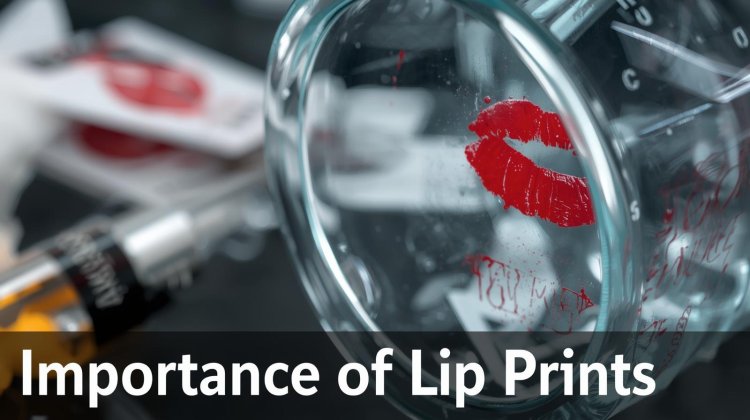
The scientific study of lip prints for identification is called cheiloscopy.
Scientific Basis of Lip Prints as Evidence
Lip prints are accepted as forensic evidence based on three major principles:
a) Uniqueness
-
No two individuals (even identical twins) have exactly the same lip print patterns.
-
Variations occur in shape, length, branching, and intersection of grooves.
b) Permanence
-
Lip patterns do not change with age.
-
Minor injuries heal without altering groove patterns.
c) Individuality
-
Even different areas of the same lip show different groove arrangements.
-
This allows comparison using quadrant-wise analysis.
Anatomy Relevant to Lip Prints
-
Vermilion zone: The most important area for lip print analysis
-
Labial grooves (sulci labiorum): These grooves form the identifiable patterns
-
Upper and lower lips are often divided into quadrants for systematic study
Classification of Lip Prints (Suzuki–Tsuchihashi)
This is the most widely used classification system:
| Type | Description |
|---|---|
| Type I | Clear, complete vertical grooves |
| Type I′ | Partial vertical grooves |
| Type II | Branched (Y-shaped) grooves |
| Type III | Intersecting grooves |
| Type IV | Reticular (net-like) pattern |
| Type V | Irregular / unclassified patterns |
In practice, a combination of types is usually seen in a single individual.
Types of Lip Prints at Crime Scenes
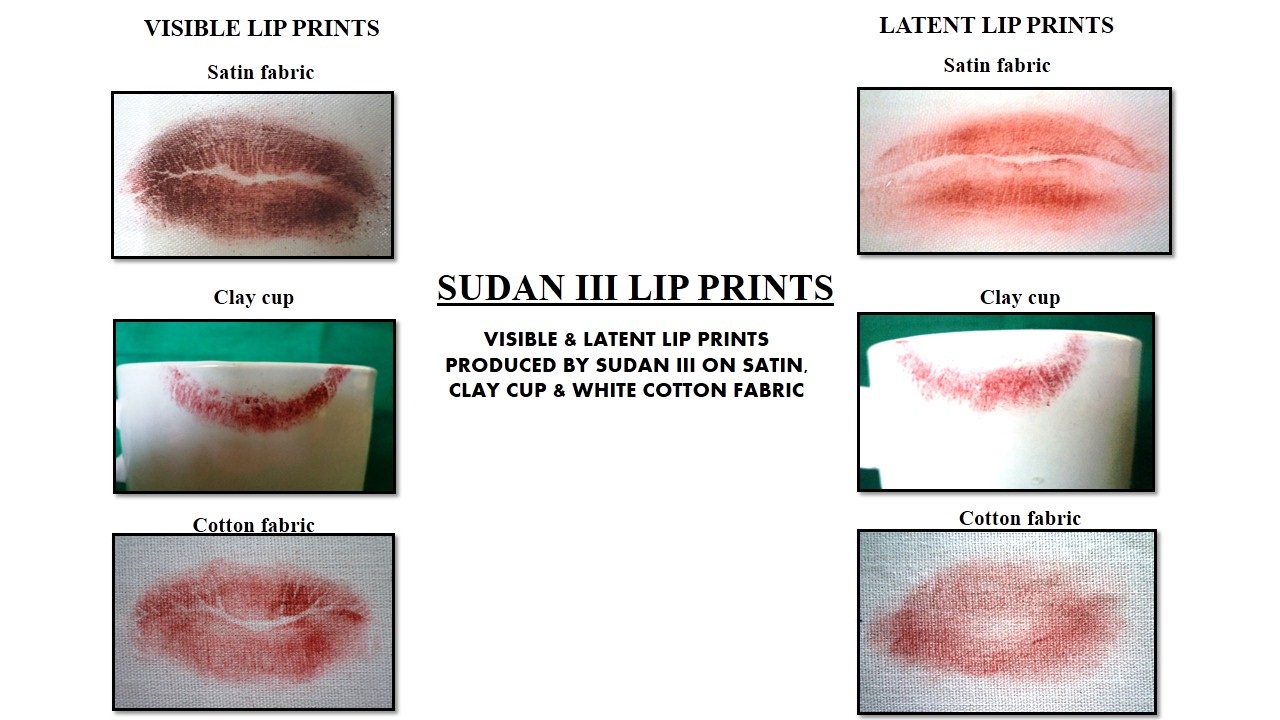
a) Visible Lip Prints
-
Seen directly with naked eyes
-
Commonly caused by lipstick or colored cosmetics
-
Found on glasses, cups, napkins, cigarettes, skin, mirrors
b) Latent Lip Prints
-
Invisible to the naked eye
-
Made by natural secretions (oil and sweat)
-
Require development techniques similar to fingerprints
Development and Collection of Lip Prints
Development Techniques
-
Fingerprint powders (black, magnetic, aluminum)
-
Lysochrome dyes (Sudan III, Sudan Black – useful for oily prints)
-
Fluorescent dyes under alternate light sources
Collection Methods
-
High-resolution photography
-
Lifting with adhesive tape (after development)
-
Digital enhancement and comparison

Comparison and Analysis
Comparison involves:
-
Groove direction
-
Branching pattern
-
Intersection points
-
Thickness and continuity of grooves
Analysts compare:
-
Crime scene lip print
-
Known (control) lip print of suspect
Comparison may be done manually or using digital image analysis software.
Forensic Applications of Lip Prints
Lip prints help in:
-
Personal identification
-
Linking a suspect to a crime scene
-
Excluding innocent suspects
-
Supporting evidence in sexual assault, homicide, burglary, and assault cases
-
Sometimes assisting in sex determination (females often show more Type I and I′ patterns)
Legal Value of Lip Prints
-
Lip prints are considered corroborative evidence, not primary evidence
-
Courts prefer them to be supported by:
-
Fingerprints
-
DNA
-
Serology or other physical evidence
-
Their admissibility depends on:
-
Proper collection
-
Clear documentation
-
Expert testimony

Limitations of Lip Print Evidence
-
Smudging and distortion are common
-
Partial prints reduce reliability
-
No universal lip print database
-
Environmental factors (heat, moisture, pressure) affect quality
-
Less standardized than fingerprints
Follow cyberdeepakyadav.com on
Facebook, Twitter, LinkedIn, Instagram, and YouTube
What's Your Reaction?