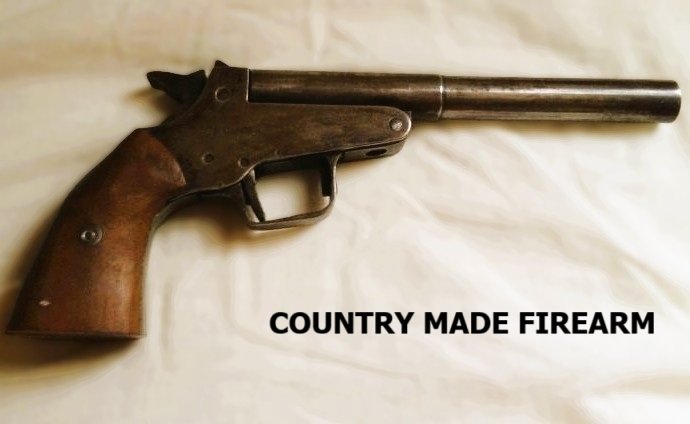
Country Made Firearm - Desi katta
When a firearm is created locally by individuals or small workshops using easily accessible materials, as opposed to by a reputable guns manufacturer, it is considered a country-made firearm. The phrase is frequently used to refer to handcrafted, artisanal, or improvised firearms in news stories, law enforcement, and legal settings.
Why they’re made and used
-
Accessibility: where legal firearms are hard to buy, people turn to local makers.
-
Cost: cheaper than factory firearms.
-
Anonymity: unregistered weapons are harder to trace.
-
Cultural or rural practices: in some rural areas, improvised guns are made for pest control or hunting where store‑bought options are scarce.
Common characteristics
-
Crude construction: simple designs (single‑shot pistols or shotguns are common), often using pipe, sheet metal, or repurposed parts.
-
No serial numbers / no documentation: they’re usually unregistered and untraceable.
-
Minimal safety features: lacking safeties, reliable locking systems, or proper sights.
-
Limited longevity and reliability: they can jam, misfire, or fail catastrophically (explode) under use.
-
Designed for local ammunition or common calibers: makers often try to accommodate readily available cartridges, but exact tolerances are poor.
Classification of “country‑made” (homemade/improvised) firearms
A useful, non-technical classification for describing or classifying domestically produced guns for reporting, law enforcement, research, or safety purposes is provided below. Only high-level descriptive categories will be provided; no construction instructions will be given.
1) By basic type (form factor)
-
Pistol / Handgun — short barrel, designed to be fired with one hand (often single‑shot or very crude multi‑shot).
-
Rifle — longer barrel, shoulder‑fired; uncommon but sometimes improvised for greater range/accuracy.
-
Shotgun — common in country‑made form (single‑shot or short pump/slide copies) and often used for hunting or close range.
-
Zip gun / makeshift handgun — extremely crude, often improvised from pipes and simple firing mechanisms.
-
Hybrid / Converted — factory parts (e.g., a toy gun, airgun, or blank‑firing cartridge gun) converted to fire live ammunition.
2) By action/mechanism (how they fire)
-
Single‑shot / Break‑action — load one round at a time; simplest and most common.
-
Manual repeaters — improvised bolt/pump/lever systems (rare, more complex).
-
Fixed‑breech with disposable cartridges — crude firing pin/hammer striking a cartridge primer.
-
Percussion cap / muzzle‑loading style — very rare today but still possible in some regions.
-
Converted/modified commercial mechanisms — altered factory mechanisms to change caliber or firing mode.
3) By manufacturing method / materials
-
Pipe/tube guns — barrel formed from metal tubing (very common descriptor).
-
Machined/homemade barrel — better made, turned on lathe (higher risk of misuse but potentially stronger).
-
Repurposed parts — built from spare parts (car parts, bicycle springs, blank‑firing pistols).
-
Welded sheet/plate constructions — body or frame made from cut/welded metal plates.
-
Mixed (part‑factory, part‑homemade) — a commercially made barrel or frame combined with improvised components.
4) By ammunition/calibre
-
Common civilian calibres — adapted to widely available cartridges (e.g., .22, 9mm, 12‑gauge) because they’re easier to source.
-
Non‑standard / improvised calibres — poorly chambered, mismatched cartridges — higher failure risk.
-
Single‑shot fixed‑chamber sub‑calibres — made to fire one common cartridge type only.
5) By intended use / concealability
-
Concealable (small handguns/zip guns) — designed to be hidden.
-
Field/hunting (short shotguns, rustic rifles) — used for pest control or hunting.
-
Criminal/weaponised — deliberately made for use in crime (often lower quality but greater anonymity).
-
Utility/ceremonial — locally made for non‑violent uses in some cultures (rare).
6) By legal/forensic status
-
Unregistered / Unserialled — no serial number, no official record.
-
Illicitly manufactured — made without required licences or in contravention of laws.
-
Converted legal firearm — originally legal but modified illegally (e.g., altered capacity or firing capability).
-
Forensically traceable — despite lacking serial numbers, tool marks, unique machining, or recovered parts may link weapon to maker/user.
7) By safety/reliability risk
-
Very high risk — crude materials, weak barrel, poor chamber fit — high chance of catastrophic failure.
-
Moderate risk — better machining or use of some factory parts; still potentially unsafe.
-
Lower (but still significant) risk — professionally made parts assembled by skilled amateur; still lacks regulatory safety testing.
8) Forensic / investigative classification markers
-
Absence of manufacturer markings/serials
-
Unique tool marks from local tools — can link multiple weapons to same workshop.
-
Improvised safety/firing mechanisms (nail pins, springs, sears) — signature patterns.
-
Ammunition adaptations — hand‑modified cartridges or re‑chambering evidence.
-
Corrosion/age and DIY repairs — telltale signs of long use and local maintenance.

Nomenclature for “country‑made” firearms
Short labels / acronyms
-
CMF — Country‑Made Firearm (generic).
-
Zip gun — extremely crude, often single‑shot handheld improvised pistol.
-
Pipe gun — barrel made from metal tubing or pipe.
-
Improvised firearm / IF — broad descriptor used in reports.
-
Converted firearm — originally commercial, later illegally modified.
-
Hybrid — part factory, part handmade components.
Type / form‑factor terms
-
Pistol / Handgun (single‑shot, improvised)
-
Shotgun (single‑shot, smoothbore common)
-
Rifle (longer barrel, shoulder‑fired)
-
Break‑action / single‑shot break
-
Bolt / pump / lever (rare in country‑made but sometimes used)
-
Muzzleloader (very uncommon; older style)
Common part names
-
Barrel — rifled or smoothbore (note: many CMFs are smoothbore).
-
Chamber — area that holds the cartridge.
-
Breech / breech block — rear of the barrel; point of ignition/contact.
-
Firing pin / striker / nail‑pin (term used when improvised)
-
Hammer — striking element (may be improvised).
-
Trigger / sear — firing control mechanism.
-
Frame / receiver — main structural body.
-
Stock / butt / grip — shoulder support or handhold.
-
Muzzle — barrel front.
-
Sight / front sight / rear sight — aiming aids (often absent or crude).
-
Extractor / ejector — if present, mechanisms for removing spent cases.
Common ammunition types
Small pistol cartridges (commercial rounds used as-is)
Many country-made pistols are chambered for common commercial cartridges such as 8 mm / 0.315″ (often labelled .315), 7.65 mm, .32, .38, 7.62×??/7.63 mm, and occasionally 9 mm. These cartridges are used because they’re available and the crude barrels can accept them.
Converted or improvised cartridges / hand-loads
Makers often reload spent cases, shorten or reshape cases, or cast crude lead bullets to fit a homemade chamber. These are variable in quality and pressure.
Shotgun shells (12-bore / 12-gauge and similar)
Country-made smoothbore “kattas” and improvised shotguns commonly use 12-bore / 12-gauge shotgun cartridges (or locally available equivalents). These may be factory shells or locally assembled cartridge wads/shot.
Blank or modified blank cartridges / flare-type conversions
In some zip-guns or improvised weapons, blank cartridges or flare-type devices are modified to act as propellant for a projectile. This is dangerous and unreliable.
Commercial rifle cartridges used in crude form
In some regions you’ll find country-made pistols/revolvers built to fire .303, 7.62 or other military rifle cartridges, either singly or in crude chambers. These generate high pressures and increase the risk of catastrophic failure.
Forensic implications
Ballistic identification is harder but not impossible. Lack of serial numbers and standardized rifling complicates linking, but tool-marks on bullets/casings (firing pin, breech face, extractor marks) and unique maker marks can still provide forensic leads.
Smoothbore country-made weapons firing shot or single slugs produce different wound patterns than rifled barrels — forensic pathologists and ballistics labs must account for that when reconstructing events.
Ammunition examination should include headstamp analysis, primer and case morphology, microtool-mark comparison, and chemical analysis of propellant or shot wad when needed.
Places where illegal “country-made” firearms (desi-kattas / improvised guns) have repeatedly been made or sourced in India. This is presented from a law-enforcement / public-safety perspective only.

Indian places / regions
Munger district (Bihar) — a long-reported hub where cottage-style gun-making and distribution have been centred; police have linked several Illicit-arms networks to this area.
Villages around Mirzapur / Bardah (Bihar) — named in investigative pieces as places with local production/repair of a range of weapons.
Western Uttar Pradesh (including Meerut, Aligarh, Moradabad and other towns) — multiple police raids and news items report makeshift factories and supply lines into the NCR and Delhi.
Parts of Madhya Pradesh (Barwani, Khargone and surrounding districts) — identified in reporting as major suppliers of country-made pistols to cities like Mumbai and Delhi.
MP–Maharashtra border communities (including makers serving Mumbai) — certain artisan communities (reported in coverage) specialise in producing and repairing small arms for old and new markets.
Rajasthan (some districts such as Alwar) — occasional busts and supply-chain links to other states reported by police.
Urban seizure hotspots (Jaipur, Patna, Delhi-NCR, Mumbai, etc.) — while manufacturing may be outside big cities, finished/part weapons and cartridges frequently surface in these urban markets.
Important legal & safety points
Manufacturing, possession, sale or transport of firearms and ammunition without a valid licence is an offence under The Arms Act, 1959 (and subsequent amendments). Enforcement actions, arrests and factory busts are common. If you encounter an illegal weapon, inform police — do not handle it.
Follow cyberdeepakyadav.com on
Facebook, Twitter, LinkedIn, Instagram, and YouTube
What's Your Reaction?