Emerging Applications of Nanotechnology in Trace Evidence Analysis
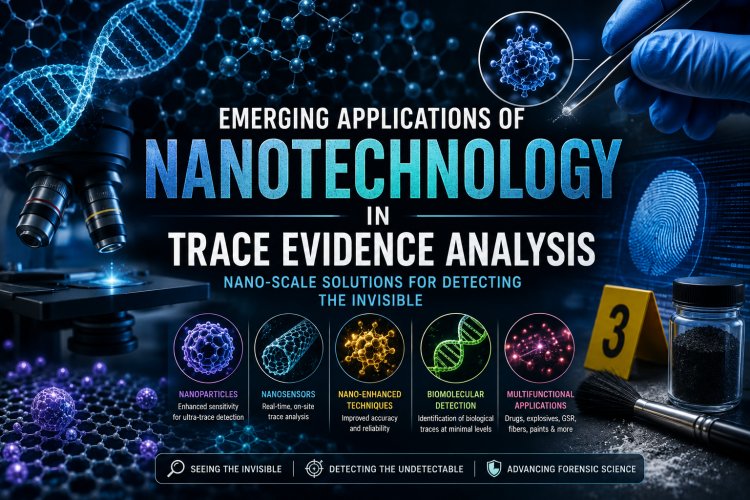
Nanotechnology and Trace Evidence Analysis together represent one of the most innovative interdisciplinary areas in modern forensic science. Nanotechnology has significantly improved the sensitivity, selectivity, speed, and accuracy of forensic laboratory investigations, particularly in the analysis of trace evidence.
Introduction to Trace Evidence Analysis
What is Trace Evidence?
Trace evidence refers to small, often microscopic materials transferred during criminal activity according to Locard’s Exchange Principle.
Common Types of Trace Evidence
- Hair
- Fibers
- Glass fragments
- Soil particles
- Paint chips
- Gunshot residue (GSR)
- Explosive residues
- Biological traces
- Ink and dyes
- Dust and nanoparticles
Importance in Forensic Investigations
Trace evidence can:
- Link suspect, victim, and crime scene
- Reconstruct events
- Identify material origin
- Support or exclude suspects
However, conventional analytical methods often face limitations due to:
- Extremely small sample quantities
- Contamination risks
- Low sensitivity
- Complex mixtures
This is where nanotechnology becomes transformative.
What is Nanotechnology?
Nanotechnology involves manipulation of matter at the nanoscale (1–100 nm).
At this scale, materials exhibit unique properties:
- Increased surface area
- Enhanced chemical reactivity
- Improved optical behavior
- Superior electrical conductivity
- Quantum effects
These properties enable highly sensitive forensic analytical systems.
Why Nanotechnology is Important in Forensic Laboratories
Advantages
| Conventional Methods | Nano-Enabled Methods |
|---|---|
| Lower sensitivity | Ultra-sensitive detection |
| Larger sample requirement | Minimal sample needed |
| Time-consuming | Rapid analysis |
| Limited selectivity | High specificity |
| Bulky instrumentation | Portable nano-devices possible |
Major Emerging Applications in Trace Evidence Analysis
A. Nanotechnology in Fingerprint Detection
Latent fingerprints are among the most important trace evidence types.
Traditional Challenges
- Weak or partial prints
- Multicolored surfaces
- Porous substrates
- Environmental degradation
Nano-Based Fingerprint Development
1. Quantum Dots (QDs)
Quantum dots are semiconductor nanoparticles with fluorescent properties.
Applications
- High-resolution fingerprint imaging
- Multicolor fluorescence detection
- Detection on difficult surfaces
Advantages
- Enhanced contrast
- High sensitivity
- Long-lasting fluorescence
Research Focus
Reducing toxicity of cadmium-based quantum dots.
2. Gold Nanoparticles (AuNPs)
Gold nanoparticles bind selectively to fingerprint residues.
Uses
- Cyanoacrylate enhancement
- Surface-enhanced Raman spectroscopy (SERS)
- Improved ridge detail visualization
3. Magnetic Nanoparticles
Magnetic nanopowders improve latent print recovery.
Benefits
- Reduced physical damage
- Better adherence
- Easier application on delicate evidence
B. Gunshot Residue (GSR) Analysis
GSR is critical in firearm investigations.
Nano-Enhanced GSR Detection
Nanomaterial Applications
- Carbon nanotubes
- Metal oxide nanoparticles
- Nano-sensors
Advantages
- Detection of ultra-trace residues
- Improved elemental specificity
- Portable detection systems
Emerging Technologies
Nano-SERS Platforms
Surface-enhanced Raman spectroscopy using nanoparticles dramatically amplifies Raman signals.
This allows:
- Identification of inorganic and organic GSR
- Faster field analysis
- Reduced false positives
C. Nanotechnology in Explosive Residue Detection
Explosive traces are often extremely minute.
Nano-Biosensors
Nanobiosensors combine:
- Nanomaterials
- Biological receptors
- Signal transducers
Applications
Detection of:
- TNT
- RDX
- PETN
- Nitroglycerin
Types of Nanomaterials Used
| Nanomaterial | Application |
|---|---|
| Carbon nanotubes | Chemical sensing |
| Graphene | Electrical signal amplification |
| Gold nanoparticles | Colorimetric explosive detection |
| Silica nanoparticles | Surface enhancement |

D. Hair and Fiber Analysis
Nanotechnology improves microscopic and chemical characterization.
Nano-Imaging Techniques
Atomic Force Microscopy (AFM)
Atomic Force Microscopy enables:
- Surface morphology analysis
- Cuticle damage examination
- Fiber surface characterization
Forensic Advantages
- Non-destructive analysis
- Nanometer-scale resolution
Nano-Spectroscopy
Surface-Enhanced Raman Spectroscopy (SERS)
Enhances Raman signals using metallic nanoparticles.
Applications
- Dye analysis
- Fiber differentiation
- Hair treatment detection
E. Soil and Geological Trace Analysis
Soil evidence often contains nano-scale mineral components.
Nanotechnology assists in:
- Mineral fingerprinting
- Heavy metal detection
- Geographic source identification
Techniques
- Nano-XRF
- Nano-SEM
- Nanoparticle mapping
F. Biological Trace Evidence
Nanotechnology enhances forensic biology.
Nano-DNA Sensors
Applications include:
- Rapid DNA hybridization
- SNP detection
- Pathogen identification
Emerging Tools
- Nanopore sequencing
- DNA nanochips
- Quantum-dot biosensors
Lab-on-a-Chip Systems
Microfluidic nano-devices integrate:
- DNA extraction
- Amplification
- Detection
onto a single chip.
Advantages
- Rapid processing
- Reduced contamination
- Portable forensic analysis
G. Drug and Toxicology Analysis
Nanotechnology improves forensic toxicology sensitivity.
Nano-Based Detection Methods
Nanoparticle Sensors
Used for detecting:
- Narcotics
- Poisons
- Synthetic drugs
- Heavy metals
Graphene-Based Sensors
Offer:
- High conductivity
- Rapid signal transmission
- Ultra-low detection limits
H. Ink, Paint, and Document Analysis
Nanotechnology aids in questioned document examination.
Applications
- Ink differentiation
- Counterfeit detection
- Nano-level pigment analysis
Techniques
- Nano-FTIR
- Nano-Raman spectroscopy
5. Important Nanomaterials Used in Forensic Science
| Nanomaterial | Forensic Application |
|---|---|
| Gold nanoparticles | Fingerprints, SERS |
| Silver nanoparticles | Optical enhancement |
| Quantum dots | Fluorescent imaging |
| Carbon nanotubes | Chemical sensing |
| Graphene | Biosensors |
| Magnetic nanoparticles | Trace evidence recovery |
| Silica nanoparticles | Surface modification |
6. Advanced Nano-Analytical Techniques
A. Surface-Enhanced Raman Spectroscopy (SERS)
Surface-Enhanced Raman Spectroscopy is among the most important forensic nano-tools.
Why Important?
Raman signals become amplified thousands to millions of times.
Applications
- Drugs
- Explosives
- Biological fluids
- Dyes
- GSR
B. Atomic Force Microscopy (AFM)
Provides ultra-high-resolution topographical imaging.
Useful for:
- Fiber damage analysis
- Surface contamination studies
- Toolmark analysis
C. Nano-SEM and Nano-TEM
Scanning Electron Microscopy (SEM)
Used for:
- GSR characterization
- Surface morphology
Transmission Electron Microscopy (TEM)
Provides internal nano-structural information.
7. Emerging Trends in Nanotechnology-Based Forensic
Laboratories
A. Portable Nano-Forensic Devices
Future crime scene tools may include:
- Handheld explosive detectors
- Portable nano-DNA analyzers
- Smartphone-integrated nano-sensors
B. Smart Forensic Sensors
AI-integrated nano-sensors capable of:
- Real-time evidence recognition
- Automated interpretation
- Wireless reporting
C. Nano-Robotics in Forensics (Experimental)
Potential future applications:
- Microscopic evidence recovery
- Cellular forensic analysis
- Precision toxicology
Research Gaps in Nanotechnology and Trace Evidence
Several areas remain underexplored.
Promising Research Gaps
1. AI + Nano-Forensics
Integration of machine learning with nano-sensor data.
2. Green Nanotechnology
Development of eco-friendly nanoparticles.
3. Portable Nano-Laboratories
Field-deployable forensic systems.
4. Nano-Biosensors for Mixed Biological Samples
Rapid separation and identification of contributors.
5. Standardization Protocols
Need for international validation guidelines.
Future Scope
Nanotechnology is expected to transform forensic laboratories into:
- Faster analytical systems
- Portable forensic units
- Highly sensitive detection centers
- Automated evidence analysis platforms
Future forensic laboratories may combine:
- Nanotechnology
- Artificial intelligence
- Robotics
- Microfluidics
- Real-time data analytics
into integrated smart forensic systems.
Follow cyberdeepakyadav.com on
Facebook, Twitter, LinkedIn, Instagram, and YouTube
What's Your Reaction?