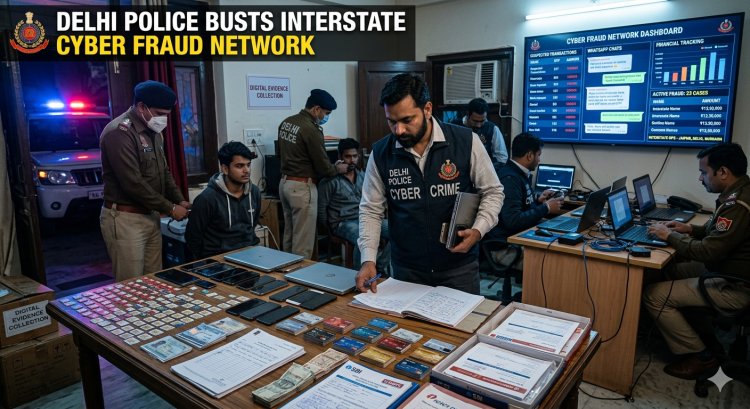
Delhi Police Busts Interstate Cyber Fraud Network Supplying Bank Account Kits and SIM Cards
Delhi Police Cyber Cell busted an interstate cyber fraud network involved in supplying bank account kits, SIM cards, ATM cards, and banking credentials to cybercriminals across multiple states after a ₹90,000 KYC scam complaint.
Delhi Police Busts Interstate Cyber Fraud Network Supplying Bank Account Kits
and SIM Cards
The Central District Cyber Police of Delhi Police has dismantled an organised interstate cyber fraud network involved in supplying bank account kits, SIM cards, ATM cards, and banking credentials to cybercriminal syndicates operating across multiple states.
The operation was carried out after a detailed investigation involving technical surveillance, financial trail analysis, digital profiling, and coordinated raids in Haryana and Punjab, officials said on Wednesday.
Fraud Began With KYC Pretext
The investigation started after a complaint was filed by a tea seller from South Patel Nagar, Delhi. According to police, an unidentified individual visited the victim’s shop posing as a fintech company employee. On the pretext of updating KYC settings on the victim’s mobile phone, the accused allegedly gained unauthorised access to the device and fraudulently transferred ₹90,000 from the victim’s bank account.
Following the complaint, an FIR was registered on May 15 under Section 318(4) of the Bharatiya Nyaya Sanhita (BNS) at the Cyber Central Police Station.
A special investigation team comprising Sub-Inspector Ravinder Kumar, Head Constable Deepak, and Head Constable Jai Kishan was formed under the supervision of SHO Inspector Yograj Dalal and ACP Padam Singh Rana.
Investigation Process
Police officials stated that the cyber fraud amount was routed through a beneficiary account maintained in a public sector bank. Investigators conducted:
- Technical surveillance
- Beneficiary account verification
- CCTV footage examination
- Financial transaction analysis
- Digital profiling
- Field intelligence operations
Based on technical inputs and local intelligence, multiple raids were conducted in Panchkula, Zirakpur, and nearby regions of Haryana and Punjab.
The sustained investigation ultimately led to the arrest of three accused persons on May 19.
Arrested Accused and Their Roles
| Name | Age | Location | Alleged Role |
|---|---|---|---|
| Vishesh Singh | 22 | Panchkula, Haryana | Beneficiary account holder and supplier of bank account kits and SIM cards |
| Sachin Maurya | 22 | Panchkula, Haryana | Facilitator responsible for collecting and distributing account kits |
| Ashish Sharma | 27 | Una, Himachal Pradesh | Handler and interstate supplier of multiple bank account kits |
Modus Operandi of the Cyber Fraud Network
According to investigators, the accused acted as intermediaries for organised cyber fraud syndicates. They allegedly earned commissions by arranging:
- Bank accounts
- ATM cards
- Registered SIM cards
- Internet banking credentials
These resources were then used by cybercriminals to route, transfer, and withdraw stolen funds.
Digital Evidence Recovered
During forensic examination of seized mobile phones, police reportedly recovered:
- WhatsApp chats related to account supply operations
- Commission distribution records
- Instagram communications with associates
- Details of mule bank accounts
- Suspicious digital payment references
Officials also stated that several mobile numbers, social media accounts, and beneficiary bank accounts identified during the investigation may be linked to other complaints registered on the National Cybercrime Reporting Portal (NCRP).
Four mobile phones used in the operation were seized during the raids.
Cyber Fraud Supply Chain Structure
Victim
   ↓
Fraudster posing as fintech/KYC agent
   ↓
Money transferred from victim account
   ↓
Beneficiary/Mule Bank Accounts
   ↓
Handlers & Facilitators
   ↓
Cash Withdrawal / Further Transfers
   ↓
Cyber Fraud Syndicates
Investigation Flow Chart
Complaint Filed
      ↓
FIR Registered
      ↓
Special Cyber Team Formed
      ↓
Technical Surveillance & Financial Analysis
      ↓
Raids in Haryana & Punjab
      ↓
Identification of Accused
      ↓
Arrest of Three Operatives
      ↓
Digital Evidence Recovery
      ↓
Further Investigation Ongoing
Key Findings of the Investigation
1. Organised Cybercrime Structure
The case highlights how modern cyber fraud networks operate through organised supply chains involving handlers, facilitators, and mule account providers rather than individual scammers alone.
2. Misuse of Digital Trust
The fraud exploited public trust through fake KYC and fintech verification tactics, a rapidly growing method in cybercrime cases across India.
3. Role of Mule Accounts
The investigation exposed the critical role of “mule bank accounts” used to temporarily receive and route stolen money before withdrawal or redistribution.
Cyber Safety Advisory for Citizens
Police officials advise citizens to:
- Never hand over mobile phones to unknown individuals
- Avoid sharing OTPs, banking credentials, or PINs
- Verify KYC requests directly through official banking channels
- Enable transaction alerts and app locks
- Report cyber fraud immediately on the NCRP helpline (1930) or portal
Conclusion
The Delhi Police operation underscores the growing sophistication of cybercrime networks in India. Rather than functioning through isolated fraudsters, these syndicates rely on organised logistical support involving bank accounts, SIM cards, and digital identities.
Authorities stated that further investigation is underway to identify additional accused persons, trace more beneficiary accounts, and uncover links to other cyber fraud complaints across the country.
Follow cyberdeepakyadav.com on
Facebook, Twitter, LinkedIn, Instagram, and YouTube
What's Your Reaction?