Forensic Voice and Audio Analysis
A voice recording can look like an ordinary audio file—perhaps a WhatsApp voice note, a phone call, CCTV audio, a threatening call, a hidden recording, or a social-media clip. But from a forensic perspective, that small audio file can contain a surprising amount of information. Who is speaking? What exactly was said? Has the recording been edited? Can unclear speech be recovered? Does the questioned voice show similarities with a known person's voice? Was the recording made on a particular device or in a particular environment?
These are the kinds of questions addressed through forensic voice and audio analysis.
Audio forensics combines acoustics, digital signal processing, speech science, phonetics and forensic methodology to examine recordings for investigative and legal purposes. The major areas include enhancement, authentication, signal analysis and speaker comparison
1. What is Forensic Voice Analysis?
Forensic voice analysis is the scientific examination of speech or voice recordings to obtain information that may be relevant to a legal investigation.
It may involve examining:
- speech characteristics
- pronunciation
- accent
- speaking style
- pitch
- formant frequencies
- timing and rhythm
- voice quality
- linguistic characteristics
- acoustic characteristics
- recording conditions
When a questioned recording is compared with a known recording from a suspect, the process is commonly called forensic speaker comparison.
An important point is that forensic speaker comparison is not simply listening to two voices and saying, "They sound the same."
A proper examination considers multiple features and the limitations of the recordings. Modern forensic voice comparison commonly uses auditory, acoustic-phonetic, spectrographic and sometimes automatic approaches.

2. What is Forensic Audio Analysis?
Forensic audio analysis is broader than voice analysis.
It deals with the scientific examination of recorded sound for investigative purposes.
The major areas are:
1. Audio Enhancement
Making relevant sounds more intelligible while preserving the original evidence.
2. Audio Authentication
Examining whether a recording appears original, altered, manipulated or inconsistent with its claimed history.
3. Voice/Speaker Comparison
Comparing questioned and known speech samples.
4. Signal Analysis
Examining acoustic signals and their characteristics.
5. Recording and Device Analysis
Examining technical properties of files, formats, metadata and recording systems.
The Audio Engineering Society similarly describes audio forensics in terms of enhancement, authentication and comparison/interpretation.
3. Imagine a Real Investigation
Suppose police receive a threatening phone call.
The caller says:
"You know what you have done. You have three days."
The recording is noisy. There is traffic in the background, the voice is partially distorted and the recording was captured through a mobile phone.
Investigators may ask:
Question 1: Can we understand the speech better?
→ Audio enhancement.
Question 2: Is the recording genuine or has it been edited?
→ Authentication examination.
Question 3: Is the speaker potentially the same person as a known suspect?
→ Forensic speaker comparison.
Question 4: What characteristics can be observed in the speaker's voice?
→ Acoustic and phonetic analysis.
This is where forensic voice analysis becomes useful.

4. The First Rule: Preserve the Original
Before doing any enhancement or analysis, the original recording should be preserved.
This is extremely important.
An examiner should ideally work from a forensic copy while retaining the original evidence.
The examination may involve:
Original evidence
↓
Hash / identification / documentation
↓
Forensic working copy
↓
Analysis
↓
Enhanced or derived output
↓
Report
Digital audio authentication procedures can include hashing/cloning, file and data analysis, playback/conversion considerations, temporal and frequency analysis, and detailed work notes.
5. What Information Can an Audio File Contain?
An audio file is more than sound.
Depending on the file and acquisition process, an examiner may examine:
- file format
- sampling rate
- bit depth
- number of channels
- duration
- codec
- compression
- metadata
- timestamps
- waveform
- frequency information
- background sounds
- discontinuities
- editing artefacts
For example, two files may both contain a voice recording, but one could be an original WAV recording while another could be a heavily compressed social-media copy.
That difference can significantly affect forensic analysis.

6. Waveform Analysis
A waveform represents changes in the audio signal over time.
You have probably seen an audio waveform while editing a reel or video.
It looks something like:
small signal → large signal → silence → large signal
The waveform can help an examiner examine:
- speech activity
- silence
- amplitude
- clipping
- sudden changes
- repeated sections
- possible edits
- signal structure
But a waveform alone normally does not tell us who is speaking.
It is one component of a larger examination.
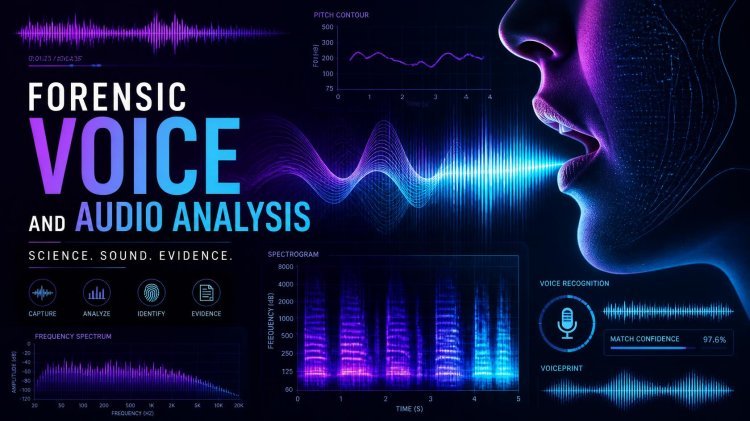
7. What is a Spectrogram?
A spectrogram is one of the most important visual tools in voice and audio analysis.
Think of it as a visual map of sound.
Generally:
- X-axis → time
- Y-axis → frequency
- brightness/intensity → strength of frequency components
Speech produces complex patterns because the vocal tract continuously changes as we speak.
A spectrogram can reveal patterns associated with:
- vowels
- consonants
- formants
- pitch
- harmonics
- transitions
- background noise
This is why forensic voice analysis often combines what the examiner hears with what can be measured acoustically.
8. Important Voice Characteristics

A. Fundamental Frequency — F0
The fundamental frequency, commonly called F0, is related to the rate at which the vocal folds vibrate.
It contributes strongly to our perception of pitch.
Forensic analysis can examine F0-related characteristics, but F0 alone is not a unique identifier.
It changes with:
- emotion
- speaking style
- age
- health
- fatigue
- intentional voice modification
- recording conditions
9. Formant Frequencies
This is a particularly important concept in forensic phonetics.
When we speak, the vocal tract acts as an acoustic filter.
The resonant frequencies produced by this system are called formants.
They are commonly labelled:
- F1
- F2
- F3
- etc.
Formants are particularly useful in examining vowel sounds and speech characteristics.
For example, two people saying the same vowel may produce different acoustic patterns because of differences in their vocal-tract configuration and speech habits.
Research on forensic voice comparison has used acoustic-phonetic features such as formant-related measurements and fundamental frequency, but performance depends strongly on the actual case conditions.

10. Pitch Is Not the Same as Voice Identity
This is an important myth to understand.
Someone may say:
"The pitch sounds identical, therefore it is the same person."
That is not scientifically sufficient.
Pitch can change intentionally or naturally.
A person's voice can change because of:
- stress
- illness
- age
- tiredness
- emotional state
- alcohol or drugs
- speaking loudly
- whispering
- intentionally disguising the voice
Therefore, forensic voice comparison considers multiple characteristics together, not one characteristic in isolation.
11. Auditory Analysis
Technology is important, but the examiner also listens carefully.
Auditory analysis may consider characteristics such as:
- accent
- pronunciation
- articulation
- speaking rate
- rhythm
- intonation
- voice quality
- pauses
- habitual pronunciation
- disfluencies
Forensic voice comparison has historically involved both auditory and acoustic approaches, with modern methodologies integrating multiple sources of information.
The examiner may listen repeatedly to questioned and reference samples while documenting relevant observations.
12. Acoustic Analysis
Acoustic analysis converts aspects of speech into measurable information.
Possible measurements include:
Frequency
How frequently a component of the signal occurs.
Amplitude
Signal strength.
Duration
How long a sound or speech segment lasts.
F0
Fundamental frequency.
Formants
Resonance-related frequency characteristics.
Spectral characteristics
How energy is distributed across frequencies.
Voice quality
Features associated with how the voice is produced.
The examiner then considers whether the observations are informative under the particular recording conditions.
13. Audio Enhancement
Now imagine this recording:
"Hello... [traffic] ...meet me at..."
The important speech is buried under background noise.
Audio enhancement attempts to improve intelligibility.
Common processes can include:
- noise reduction
- filtering
- equalization
- hum reduction
- removal/reduction of certain interference
- gain adjustment
- spectral processing
NIST's forensic terminology defines audio enhancement as processing/filtering intended to improve signal quality and intelligibility, such as by attenuating noise or increasing the signal-to-noise ratio.

But there is a major forensic principle:
Enhancement does not mean creating information that was never present.
If a word was completely absent from the recording, software cannot scientifically "recover" the original word simply by making the audio clearer.
Enhancement should therefore be carefully documented and the untreated/original material retained.
14. Authentication of Audio Recordings
Imagine someone submits an audio recording as evidence.
The investigator needs to know:
Can this recording be relied upon as an authentic representation of the claimed event?
Authentication examination can involve looking for indications of:
- editing
- splicing
- discontinuities
- re-encoding
- unusual compression
- inconsistent metadata
- changes in signal characteristics
- unexplained temporal gaps
Digital audio authentication can include both file-level examination and analysis of the audio signal itself.
15. What is Voice Comparison?
This is probably the most famous application of forensic voice analysis.
Suppose investigators have:
Questioned recording
A voice from an unknown caller.
and
Reference recording
A legally obtained sample from a known person.
The examiner compares the two.
The question is not simply:
"Do these voices sound similar?"
A more scientifically appropriate question is:
How strongly do the observed similarities and differences support one proposition over another, considering the relevant population and recording conditions?
This is why modern forensic speaker comparison often uses a likelihood-ratio framework.

Automatic Speaker Recognition vs Forensic Voice Comparison
These terms are related but should not be treated as identical.
Automatic Speaker Recognition
Computer algorithms compare voice samples and produce scores or classifications.
Forensic Speaker Comparison
A forensic examination evaluates evidence within a scientifically validated framework and considers:
- recording conditions
- language
- speaking style
- channel differences
- sample quality
- population characteristics
- limitations
- competing propositions
Modern forensic practice therefore requires more than simply running a recording through a voice-recognition application.
Gunshot and Acoustic Event Analysis
Forensic audio can also examine non-speech events.
For example:
- gunshots
- explosions
- alarms
- breaking glass
- impacts
- vehicle sounds
- machinery
- sirens
An audio waveform and spectrogram can help examine the temporal and frequency characteristics of such events.
This becomes particularly interesting when audio is recorded by:
- CCTV
- smartphones
- surveillance systems
- smart devices
- body cameras
Deepfake Voice and Synthetic Audio
This is becoming increasingly important.
Modern AI can generate highly realistic synthetic speech.
For example, a criminal might create an artificial voice message that sounds like:
a family member
a police officer
a company executive
a government official
This creates a new challenge for forensic audio.
Investigators may need to consider:
- synthetic speech artefacts
- inconsistencies in recording characteristics
- compression history
- metadata
- spectral characteristics
- unnatural prosody
- editing
- provenance
But detecting AI-generated speech is a rapidly developing field, and no single technique should automatically be treated as infallible.
A Forensic Audio Investigation Workflow

A practical workflow can look like this:
STEP 1 — Evidence acquisition
Obtain the original recording and associated device/file information where available.
↓
STEP 2 — Preservation
Preserve the original and document handling.
↓
STEP 3 — File examination
Examine format, codec, metadata and technical characteristics.
↓
STEP 4 — Initial listening
Listen to the original recording without unnecessary processing.
↓
STEP 5 — Signal analysis
Examine waveform, spectrogram and other signal properties.
↓
STEP 6 — Enhancement
Where justified, create documented enhanced working versions.
↓
STEP 7 — Authentication
Look for indications relevant to originality or editing.
↓
STEP 8 — Voice examination
If appropriate, perform auditory and acoustic-phonetic analysis.
↓
STEP 9 — Comparison
Compare questioned and reference samples using an appropriate methodology.
↓
STEP 10 — Interpretation
Evaluate the strength and limitations of the findings.
↓
STEP 11 — Reporting
Prepare a clear, reproducible forensic report.
Software and Tools
Depending on the laboratory and examination, forensic audio specialists may use tools for:
- waveform editing/inspection
- spectral analysis
- noise reduction
- audio authentication
- speech analysis
- speaker comparison
- metadata/file analysis
Examples in the wider forensic-audio ecosystem include Praat for phonetic analysis, iZotope RX for audio restoration/processing, Adobe Audition for audio analysis/processing, and specialized forensic platforms such as Cedar or speaker-comparison systems.
The important forensic point is that software does not make an examination scientific by itself. The examiner needs validated methods, appropriate training, documentation and awareness of limitations. ENFSI's best-practice material emphasizes practitioner competence, documented training and ongoing assessment.
Follow cyberdeepakyadav.com on
Facebook, Twitter, LinkedIn, Instagram, and YouTube
What's Your Reaction?