Fingerprint Analysis (Dactyloscopy)
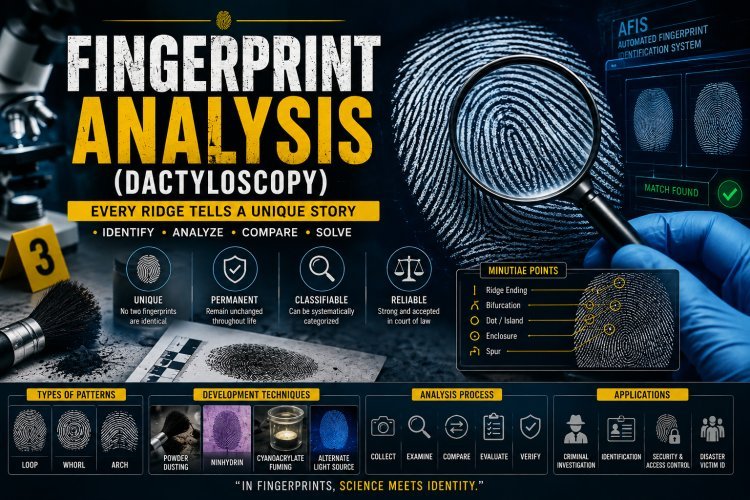
Fingerprint analysis—also known as dactyloscopy—is one of the oldest and most reliable methods of forensic identification. It is based on the scientific principle that no two individuals (even identical twins) have identical fingerprints, and that these patterns remain unchanged throughout life.
1. What Are Fingerprints?
Fingerprints are impressions of friction ridge skin found on:
- Fingers
- Palms
- Soles of feet
These ridges form during fetal development (around 10–16 weeks) and are influenced by both genetics and environmental factors in the womb.
Key Properties:
- Uniqueness → No two fingerprints are identical
- Permanence → Remain unchanged unless damaged deeply
- Classifiability → Can be systematically categorized

2. Types of Fingerprint Patterns
Fingerprints are broadly classified into three main types:
1. Loops (Most Common ~60–70%)
- Ridges enter from one side and exit the same side
- Types:
- Ulnar loop (toward little finger)
- Radial loop (toward thumb)
2. Whorls (~25–35%)
- Circular or spiral patterns
- Subtypes:
- Plain whorl
- Central pocket loop
- Double loop
- Accidental whorl
3. Arches (~5%)
- Simplest pattern
- Types:
- Plain arch
- Tented arch
3. Minutiae
Minutiae are specific ridge details used for identification:
Common Minutiae Points:
- Ridge ending
- Bifurcation (splitting)
- Dot / island
- Enclosure
- Spur
A match typically requires 8–16 matching points (varies by country and legal system).

4. Types of Fingerprints Found at Crime Scenes
- Latent Prints
- Invisible
- Made from sweat/oils
- Require development techniques
- Patent Prints
- Visible (blood, ink, dirt)
- Plastic Prints
- 3D impressions (wax, clay, soap)
5. Methods of Fingerprint Development
Physical Methods:
- Powder dusting (black, magnetic powders)
Chemical Methods:
- Ninhydrin → reacts with amino acids (purple color)
- Silver nitrate → reacts with salts
- Iodine fuming
Advanced Methods:
- Cyanoacrylate (superglue) fuming
- Laser / alternate light sources
6. Fingerprint Analysis Process
Step 1: Collection
- Lifting prints using tape, gel, or photography
Step 2: Examination
- Analyze pattern type and ridge flow
Step 3: Comparison
- Compare unknown print with known samples
Step 4: Evaluation
- Identify, exclude, or declare inconclusive
Step 5: Verification
- Independent expert review
???? This process is known as ACE-V Method:
- Analysis
- Comparison
- Evaluation
- Verification

7. Automated Fingerprint Identification System
- Computerized system storing millions of fingerprints
- Matches unknown prints with database records
- Used by law enforcement worldwide
Advantages:
- Fast searching
- High accuracy
- Large-scale database handling
8. Importance in Forensic Science
Fingerprint analysis is used for:
- Criminal identification
- Background verification
- Immigration control
- Disaster victim identification
It is considered strong courtroom evidence due to its scientific reliability.
Follow cyberdeepakyadav.com on
Facebook, Twitter, LinkedIn, Instagram, and YouTube
What's Your Reaction?