₹3.75 Crore Digital Arrest Scam: Gujarat Man Arrested, Fake Online Court Exposed
A 68-year-old Mumbai woman was cheated of ₹3.75 crore in a sophisticated digital arrest scam. Cyber criminals impersonated police, CBI officials, and a Supreme Court judge, staged a fake online court hearing, and routed money through mule accounts. A key accused has been arrested in Gujarat, while a pan-India CBI probe has been ordered.

₹3.75 Crore “Digital Arrest” Scam: Gujarat Man Held, CBI Probe Ordered
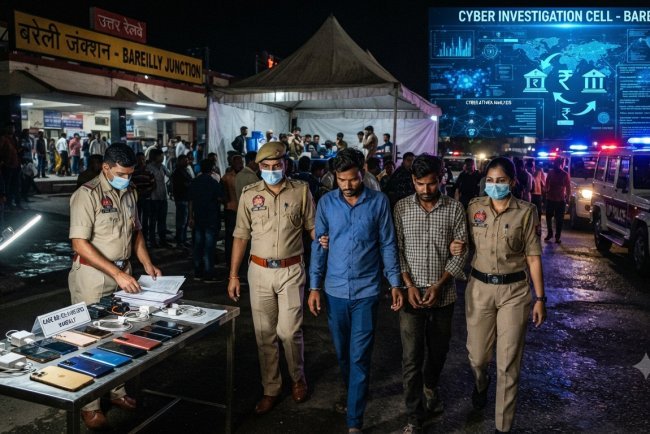
A 68-year-old Mumbai woman was defrauded of nearly ₹3.75 crore in a sophisticated “digital arrest” cyber fraud, leading to the arrest of a man from Surat, Gujarat, police officials confirmed on December 29, 2025.
According to investigators, the cyber criminals impersonated officials from the Colaba Police Station, central investigative agencies, and even staged a fake online court hearing. One of the accused falsely introduced himself as “Justice Chandrachud” during a video call, lending credibility to the elaborate scam.
Modus Operandi of the Fraud
The victim, a resident of Andheri West, received a call on August 18, in which she was informed that her bank account was allegedly involved in money laundering. The caller warned her against disclosing the matter to anyone and claimed that the case had been transferred to the Central Bureau of Investigation (CBI).
The accused, posing as Officer S.K. Jaiswal, subjected the woman to continuous surveillance, a tactic commonly referred to as digital arrest. To reinforce psychological pressure, she was asked to write a two-to-three-page personal statement and was later assured that she would be granted bail after verification.
Subsequently, the victim was made to appear before a fraudulent virtual court, where she was instructed to submit her investment and financial details. Over a period of nearly two months (August 18–October 13), she transferred funds into multiple bank accounts, resulting in a total loss of ₹3.75 crore.
Role of Mule Accounts
Investigations revealed that the money was routed through several mule accounts—bank accounts used to receive, transfer, or launder illicit funds. One such account was traced to Surat, where the accused had opened a current account using a fake cloth-trading company.
The arrested individual reportedly allowed cyber fraudsters to park ₹1.71 crore in his account in exchange for a commission of ₹6.40 lakh. He has disclosed information about two alleged masterminds, both currently based abroad, one of whom operates an immigration and visa consultancy business.
Legal Action and National Response
Following the incident, the victim approached the West Region Cyber Police Station, where a case was registered under the Bharatiya Nyaya Sanhita (BNS) and the Information Technology Act.
Recognising the growing threat of digital arrest scams, the Supreme Court of India, on December 1, directed the Central Bureau of Investigation to conduct a unified pan-India probe. The Court also urged all states to grant consent under the Delhi Special Police Establishment (DSPE) Act to facilitate nationwide investigations.
Growing Cyber Threat
Digital arrest scams have emerged as a serious form of cybercrime, wherein fraudsters exploit fear, authority, and technology by posing as law enforcement officers, judicial authorities, or government officials. Victims are psychologically intimidated and coerced into transferring large sums of money under the guise of legal proceedings.
Conclusion
This case highlights the increasing sophistication of cyber fraud networks and underscores the urgent need for greater digital awareness, stronger banking safeguards, and coordinated law enforcement action to protect vulnerable citizens, particularly senior individuals, from such crimes.
Follow cyberdeepakyadav.com on
Facebook, Twitter, LinkedIn, Instagram, and YouTube
What's Your Reaction?